Proving Swiss Origin: EUR.1, Declaration of Origin, or Supplier’s Declaration?

Table of contents
What Proofs of Origin Are Good For?
Switzerland–EU Free Trade Agreement
The agreement with the European Union (EU) has been in effect since 1972 and covers industrial products as well as processed agricultural products. The rules of origin are based on the Regional Convention on Pan-Euro-Mediterranean Preferential Rules of Origin (PEM).
Preferential Tariff: 0 Percent on Many Goods
If your goods meet the rules of origin, no import duties apply—instead of third-country rates of up to over 12 percent. The elimination of Swiss industrial tariffs as of 2024 applies only to imports; for exports, you will still need proof of preferential origin.
Requirement: Prove Swiss origin in accordance with the rules of origin
This benefit is not granted automatically: The importer must apply for it with valid proof. If the document is missing, the standard tariff applies.
A certificate of origin is not the same as proof of origin
The certificate of origin verifies non-preferential origin and is issued by chambers of commerce—for countries without free trade agreements. To qualify for preferential tariffs in the EU, you need the EUR.1 movement certificate or the declaration of origin. Our article on customs clearance in cross-border e-commerce explains the export process.
A certificate of origin is not the same as proof of origin
The certificate of origin verifies non-preferential origin and is issued by chambers of commerce—for countries without free trade agreements. To qualify for preferential tariffs in the EU, you need the EUR.1 movement certificate or the declaration of origin. Our article on customs clearance in cross-border e-commerce explains the export process.
Swiss origin—what does that actually mean?
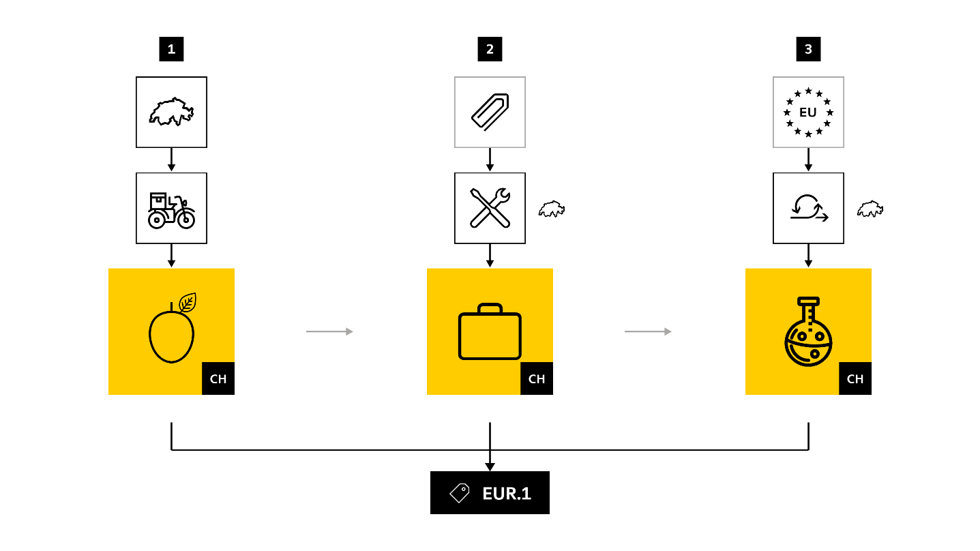
Preferential origin has nothing to do with a company’s registered office or “Swissness.” What matters is how the goods were produced.
Entirely Manufactured in Switzerland
Products entirely extracted or manufactured in Switzerland are considered originating goods without further verification.
Sufficiently worked or processed in Switzerland (list rules per HS code)
Listed rules apply to foreign input materials. They specify, for each Harmonized System (HS) heading, what confers origin: a change in heading, a maximum percentage of third-country content, or a specific processing step. Activities such as repackaging, sorting, or labeling do not, in principle, confer origin.
Cumulation with EU Origin
Materials of EU origin may be treated as Swiss. This bilateral cumulation eases many list rules; in the PEM area, diagonal cumulation is also possible.
Real-world examples
- Cosmetics: blended and bottled in Switzerland, raw materials from the EU—thanks to cumulation, they are usually considered originating goods.
- Leather goods: Leather from Italy, assembled here—the list rule is decisive.
- Electronic accessories: imported from Asia and merely repackaged—no origin, no preferential tariff.
EUR.1 – Switzerland’s formal certificate of origin
When it is required
The EUR.1 certificate is the officially certified proof of preferential origin. It is required as soon as the value of the originating products exceeds CHF 10,300 or EUR 6,000 and you are not authorized as an Authorized Exporter (AE)—this value is decisive, not the invoice amount.
Who issues it
It is completed by the exporter and certified by the Federal Office of Customs and Border Security (BAZG). Freight forwarding partners may submit it with a power of attorney, but the exporter remains responsible.
How to Apply – Step by Step
- Verify origin: calculations, bills of materials, supplier declarations.
- Enter the WVB EUR.1 – digitally in “Certificat” or on the form set.
- Enter the number in the export declaration in Passar and set “Preference” to “Yes.”
- Certification: automatically online, otherwise at the counter.
- Send the certified document to the importer.
Pro tip: The EUR.1 is now available digitally
Since the end of April 2026, the WVB EUR.1 for the PEM area can be created digitally via the free “Certificat” web application on the BAZG ePortal and certified automatically. There’s no need to visit the counter, and authenticity can be verified via a QR code.
Pro tip: The EUR.1 is now available digitally
Since the end of April 2026, the WVB EUR.1 for the PEM area can be created digitally via the free “Certificat” web application on the BAZG ePortal and certified automatically. There’s no need to visit the counter, and authenticity can be verified via a QR code.
Costs and Processing Time
Certification is free of charge; the only physical cost is the price of the form set. Digitally, it takes minutes; the traditional method involves a trip to the counter plus shipping. The effort lies in the calculation.
Validity and Retention
For trade within the EU, the EUR.1 movement certificate is valid for four months from the date of issuance; the importer must present it within this period. You must retain supporting documents for at least three years.
Declaration of Origin on the Invoice – Simplification for Amounts Up to 6,000 Euros
Threshold: up to EUR 6,000 per shipment
For origin goods valued at up to CHF 10,300 or EUR 6,000 per shipment, you may issue the declaration of origin yourself on the commercial invoice or another commercial document. The invoice currency is decisive. Unless you are an authorized exporter, the declaration must generally be signed by hand. Authorized exporters are exempt from this requirement and may issue declarations of origin regardless of the value of the goods. You must mark goods that do not have originating status accordingly.
Wording of the Declaration
The text is prescribed and may not be altered:
Sample text
“The exporter (Authorized Exporter; Authorization No. …) of the goods to which this commercial document relates declares that, unless otherwise specified, these goods are preferential origin goods from Switzerland.”
In addition, include the place, date, and—except in the case of an Authorized Exporter—the signature.
Sample text
“The exporter (Authorized Exporter; Authorization No. …) of the goods to which this commercial document relates declares that, unless otherwise specified, these goods are preferential origin goods from Switzerland.”
In addition, include the place, date, and—except in the case of an Authorized Exporter—the signature.
Who Is Eligible to Submit Declarations Without a Value Limit—Authorized Exporter (EA) Status
Those who regularly export above the value limit should apply for EA status: declarations without a value limit, no signature required. This completely eliminates the need for the EUR.1 certificate in trade with the EU.
Application for EA status
The application must be submitted in writing, along with the information form, to the relevant regional office of the BAZG. The BAZG will review your competence regarding rules of origin and your documentation procedures, which must be documented in a work and organizational instruction. The authorization is free of charge and provides you with an authorization number.
A Comparison of the Main Routes
|
Criterion |
Declaration of Origin on the Invoice |
WVB EUR.1 |
|
Value limit |
up to CHF 10,300 / EUR 6,000; no limit with EA |
Mandatory above the threshold without EA |
|
Authority involved |
no |
Yes, certification by the Federal Office of Health (BAZG) |
|
Cost |
Text block on the invoice |
Data entry, Passar, certification |
|
Signature |
Handwritten; EA exempt |
Exporter’s application |
|
Validity |
Per individual shipment |
four months from the date of issuance |
|
Typical use |
B2C parcel shipping, smaller business-to-business (B2B) shipments |
B2B for higher-value shipments |
Delivery r’s Declaration – proof within the supply chain
When You Need It
If you purchase goods in Switzerland and wish to re-export them under preferential terms, you need proof of their preferential origin, such as the supplier’s declaration from the previous supplier. This serves as the basis for your own proof of origin; when importing into the EU, the domestic supplier’s declaration generally does not constitute proof of preferential origin. The notation “Country of origin: Switzerland” is not sufficient.
Note: purely domestic document
The Swiss supplier’s declaration is valid only within Switzerland and does not serve as proof of origin for cross-border transactions. If an EU customer requests a long-term supplier’s declaration, the request is factually incorrect.
Note: purely domestic document
The Swiss supplier’s declaration is valid only within Switzerland and does not serve as proof of origin for cross-border transactions. If an EU customer requests a long-term supplier’s declaration, the request is factually incorrect.
Single and Long-Term Supplier’s Declarations
The single supplier’s declaration applies to a single shipment, while the long-term supplier’s declaration (LLE) applies to similar shipments over a defined period. If the raw materials change, the supplier must inform you immediately.
Form Templates
The BAZG publishes the binding wording in the information sheet on domestic supplier declarations; it may appear on the invoice or delivery note—but only in German, French, or Italian.
Risks of Incorrect Declarations
Anyone who makes a declaration without verifying the rules of origin is liable. If preferential treatment was granted incorrectly, the customs authority will collect the duties from the importer—and the importer will then seek reimbursement from the supplier.
REX System – What Swiss Traders Need to Know
The Registered Exporter (REX) system allows for declarations without value limits and without an authorization process. It does not apply to exports to the EU—the Switzerland–EU Free Trade Agreement does not provide for it. REX becomes relevant on the import side.
Decision Tree: Which Document for Which Shipment?
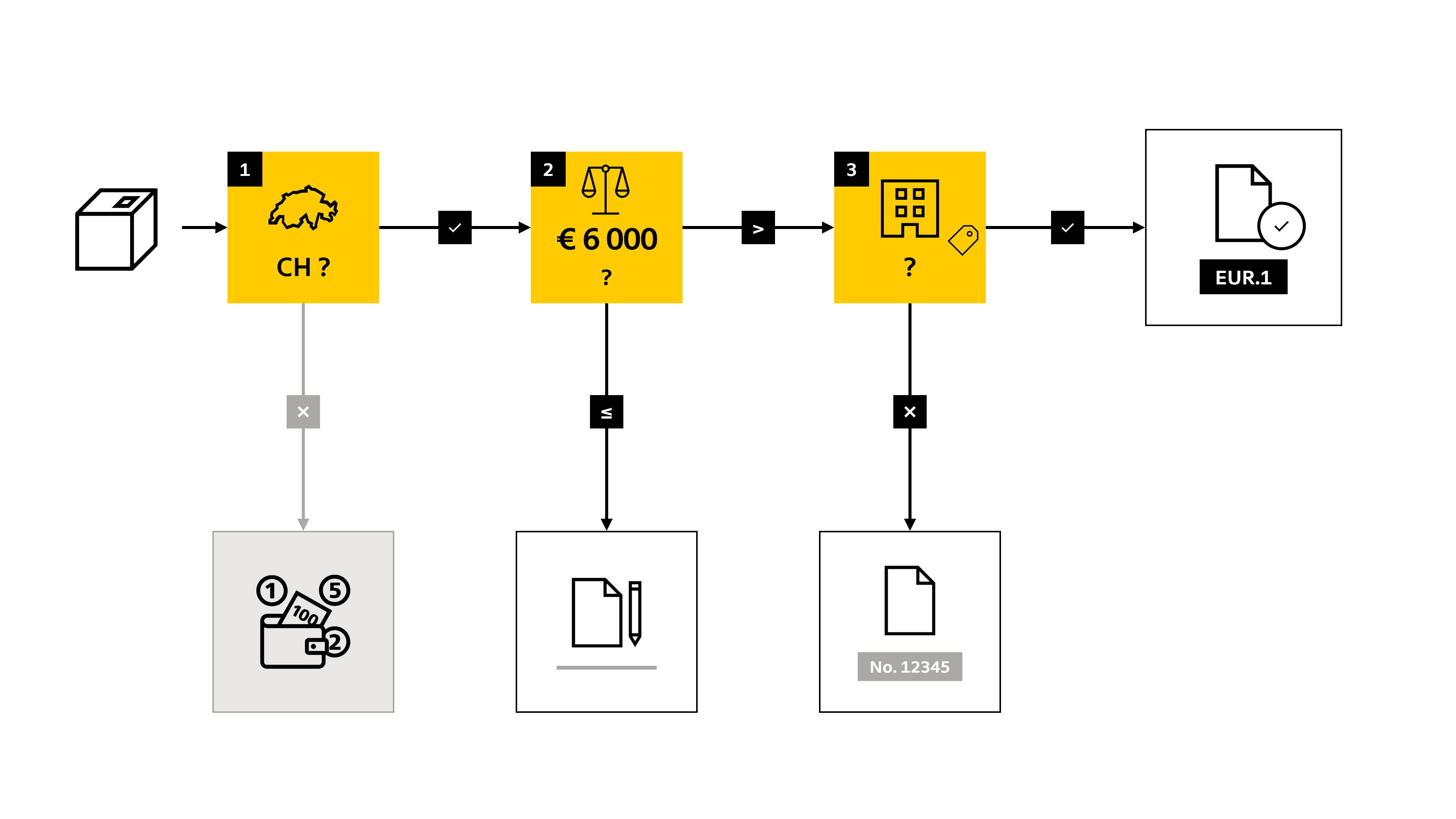
Three questions lead to the answer: Swiss origin? Value of the originating goods? Manufactured in-house or purchased?
|
Initial Situation |
The appropriate proof |
|
B2C package up to EUR 6,000 of originating goods |
Declaration of origin on the invoice, signed |
|
B2B shipment of goods of origin valued up to EUR 6,000 |
Declaration of origin on the invoice |
|
Shipment over EUR 6,000, no EA status |
EUR.1 certificate, certified by the BAZG |
|
Shipment over EUR 6,000, EA status available |
Declaration of Origin with authorization number |
|
Goods purchased in Switzerland |
Additional supplier’s declaration in the file |
|
Goods not of Swiss origin |
No proof of preferential origin; standard tariff |
Practical Checklist Before Shipping
- Origin verified: Does the HS heading’s list rule meet the requirements and is it documented?
- Correct reference value: Value of originating goods determined, not the invoice total?
- Document selected: Does the proof match the value, shipment type, and EA status?
- Formalities correct: Signature, authorization number, and labeling of third-country goods?
- File complete: Supplier declarations and calculations archived?
- Delivery arranged: Did the importer receive the document on time?
The Four Most Common Mistakes
A blanket declaration on all invoices.
Declaration made by the freight forwarder instead of the exporter.
Invoice total instead of the value of the originating goods.
Expired long-term supplier’s declaration in the dossier.
The Four Most Common Mistakes
A blanket declaration on all invoices.
Declaration made by the freight forwarder instead of the exporter.
Invoice total instead of the value of the originating goods.
Expired long-term supplier’s declaration in the dossier.
Conclusion
Preferential tariffs begin with a correct entry on the commercial invoice. For smaller and B2C-oriented retailers, the declaration of origin is sufficient; the EUR.1 certificate of origin only becomes relevant above EUR 6,000. Those who regularly exceed this threshold should utilize the EA status.
Without a reliable verification of origin, every document remains a form that carries liability risk. In cases of complex input material structures, it’s worth seeking expert clarification.
For cost optimization in exports: Cross-border e-commerce: How to export to Europe cost-effectively
Frequently Asked Questions
Do I need a certificate of origin for every export to the EU?
Proof of preferential origin is only required if your customer wishes to take advantage of the preferential tariff—otherwise, customs duties are assessed at the standard rate. For goods of origin valued up to EUR 6,000, an invoice declaration is sufficient; for amounts above that, the EUR.1 certificate or EA status is required.
What counts as the shipment value for the 6,000-euro threshold?
The value of the originating goods eligible for preferential treatment is what counts, not the total invoice amount. Goods not of Swiss origin are not included, but must be clearly marked on the document.
Can my freight forwarder submit the declaration of origin?
No, only the exporter themselves may do so. However, you may grant a power of attorney for the application for a EUR.1 certificate—the responsibility still remains with you.
How long is an EUR.1 valid?
In trade with the EU, it is valid for four months from the date of issue. The importer must present it to the customs authorities within this period.
How much does EA status cost?
The authorization is free of charge. Internal costs are incurred: an information form, work and organizational instructions, and a reliable calculation of origin.
Is the supplier’s declaration valid in trade with the EU?
No. It is a domestic document and serves solely as supporting documentation in the supply chain. For EU customs purposes, only the EUR.1 certificate or a declaration of origin on the invoice is valid.
As a Swiss retailer, do I need a REX number?
Not for exports to the EU—the EA status applies there. You’re more likely to encounter REX on the import side or in agreements outside the PEM area.
What happens if the proof of origin is missing?
The shipment will be cleared at the standard tariff rate; in the worst-case scenario, it will be held up. A EUR.1 certificate can be issued retroactively through the relevant regional office of the BAZG, but this takes time.
References
- Federal Office for Customs and Border Security (BAZG): Frequently Asked Questions on Free Trade and Preferential Origin.
- BAZG: Information Sheet on the Issuance and Use of Proofs of Origin, as of January 1, 2026 (PDF).
- BAZG: Information Sheet on Determining the Formal Validity of Proofs of Origin (PDF).
- BAZG: Authorized Exporter – Authorization Process and Requirements.
- BAZG: “Certificat” – Digital EUR.1 Movement Certificate.
- FOC: Transition to Passar Export.
- FOC: Registered Exporter (REX) for Exports.
- FOC: Information Sheets and Publications on Free Trade Agreements and Origin – Domestic (Supplier Declarations).
- FOC: Circular on the Revised PEM Agreement, Definitive Application Effective January 1, 2026 (PDF).
- Fedlex: Ordinance on the Issuance of Proofs of Origin (VAU, SR 946.32).
- Switzerland Global Enterprise: Proofs of Origin.
- Chamber of Commerce of the Two Basels: Certificates of Origin and Origin Commission.