
Which EU Countries Have Which Fees? The Shipping Costs Guide for Swiss Merchants
Table of contents
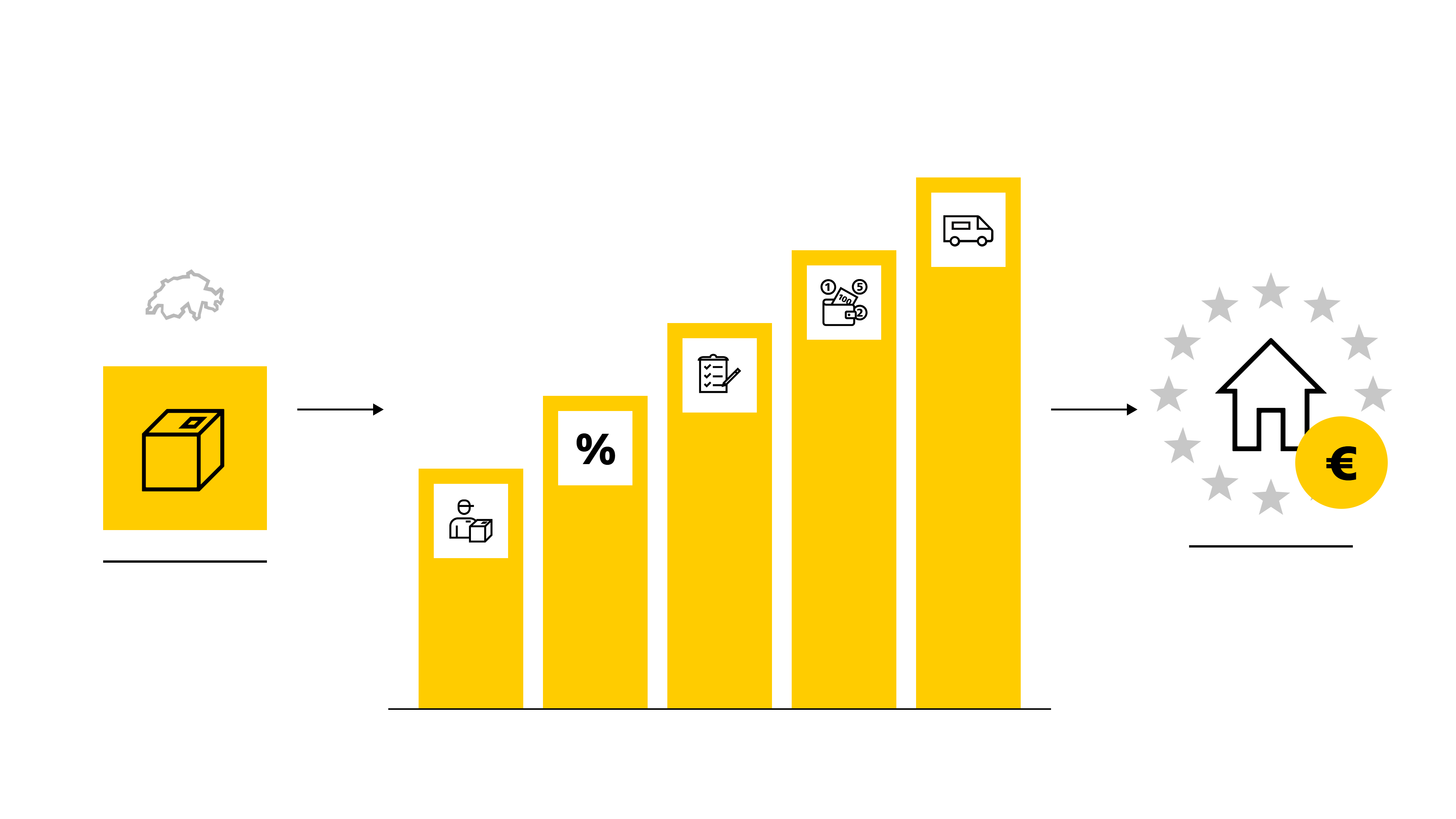
The Five Cost Components of Shipping to the EU
Every sale to the EU consists of the same five components. If you understand them, you’ll quickly see where your margin is eroded in the destination country—and where it isn’t.
Import Duties (Preferential Duties vs. Third-Country Duties)
For EU imports, the third-country duty rate generally applies—up to 12 percent for textiles. Thanks to the Switzerland–EU Free Trade Agreement, this rate drops to zero for goods with preferential Swiss or EU origin; goods from the Far East remain subject to customs duties even when shipped from a Swiss warehouse. As of July 1, 2026, the EU customs reform’s small-consignment fee will apply: EUR 3 per line item on shipments valued up to EUR 150, plus an additional EUR 2 per shipment starting in November 2026—via the postal channel, regardless of preferential origin (Source: Swiss Post). You can find the details in the article “EU Customs Reform 2026: New TPC Fee for Shipments to France Under 150 EUR.”
VAT in the Destination Country
In general, import VAT applies in the EU starting from the first euro; the rate of the respective member state applies. There is a ten-percentage-point range between 17 percent in Luxembourg and 27 percent in Hungary—which has a corresponding impact on your end customer price. The tax base is generally the customs value plus certain ancillary costs, duties, and any applicable customs duties. For shipments up to EUR 150, you can use the Import One-Stop Shop (IOSS) and collect VAT directly at checkout; without IOSS or for higher-value goods, VAT is collected as part of the import process. With DDP, you are responsible for import clearance and import duties; local VAT registration may be required, but it does not automatically follow from DDP alone.
Service Provider’s Customs Clearance Fees
Postal and courier companies charge fees for customs clearance—the key factor is who bears these costs. For shipments under Delivered at Place (DAP), the delivery partner in the destination country handles customs clearance and charges the recipient a processing fee in addition to the duties: in Germany, this is EUR 7.50 (source: Deutsche Post); elsewhere, it ranges from about 5 to 25 euros per shipment. With DDP, you handle customs clearance and duties; your customer receives the package without any additional charges. The cost depends on the service provider, service level, and customs clearance model—collective customs clearance is significantly cheaper per shipment than individual customs clearance.
DDP and DAP Explained Briefly
DDP (“Delivered Duty Paid”): As the merchant, you cover customs duties, VAT, and fees—the price at checkout is the final price.
DAP (“Delivered Duty Unpaid”): Your customer pays duties and customs clearance fees upon delivery—which carries risks for conversion rates, acceptance rates, and returns.
DDP and DAP Explained Briefly
DDP (“Delivered Duty Paid”): As the merchant, you cover customs duties, VAT, and fees—the price at checkout is the final price.
DAP (“Delivered Duty Unpaid”): Your customer pays duties and customs clearance fees upon delivery—which carries risks for conversion rates, acceptance rates, and returns.
Country-Specific Special Duties
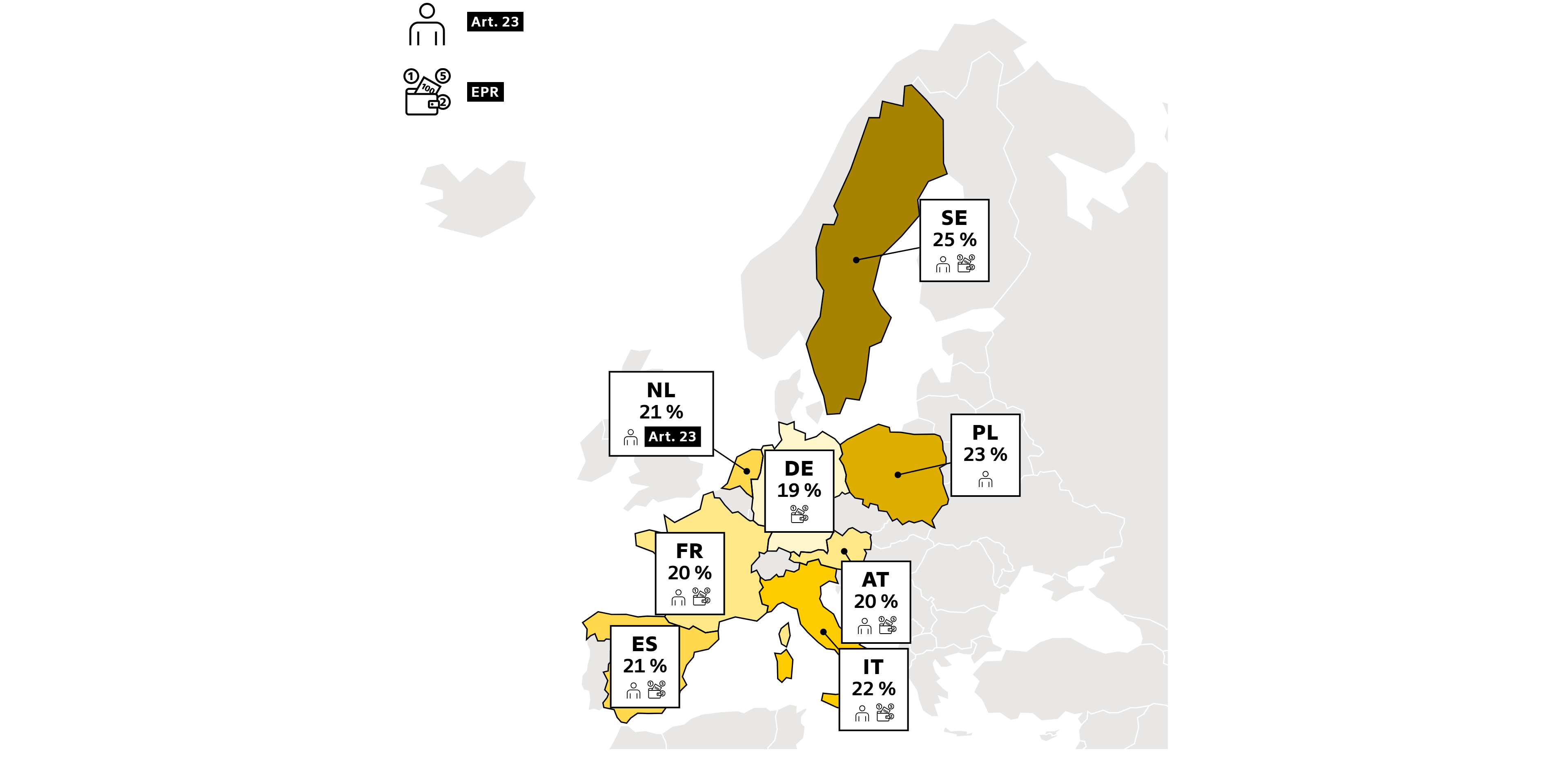
Some countries also impose their own duties that do not appear in any standard calculation: Since March 1, 2026, France has required the Taxe Petit Colis (TPC) of EUR 2 per declared item on small shipments under EUR 150; Italy charges EUR 2 per shipment; and Romania charges around EUR 5 (Source: Swiss Post). In addition, there are product-specific levies such as Spain’s plastic tax, Sweden’s chemical tax on electronics, or Extended Producer Responsibility (EPR) fees for packaging—in Germany via the LUCID packaging registry, and in France with Triman labeling. Check which special levies apply to your product range for each destination country.
Last-Mile Delivery Fees
Transportation and delivery costs also vary significantly: delivery density, distance, and the local carrier structure determine the price per package. Deliveries to Spain or Scandinavia typically cost more than those to neighboring markets; island regions incur surcharges and longer transit times. Therefore, calculate last-mile costs per destination country—not as an EU average.
Comparison Table: Costs by Destination Country
The following overview compares the twelve most important EU destination markets in terms of VAT and customs clearance fees—supplemented by country-specific factors.
|
Country |
Standard VAT |
Common Reduced Rates |
Customs Clearance Fee Range* |
Country-Specific Features |
|
Germany |
19% |
7% |
approx. 6–15 EUR |
Largest EU market; LUCID packaging registry required; direct VAT registration possible |
|
Austria |
20% |
13% / 10% |
approx. 10–15 EUR |
Culturally closest market; tax representative required; EPR obligations for packaging |
|
France |
20% |
10% / 5.5% / 2.1% |
approx. 8–15 EUR |
TPC of 2 EUR per item (effective 03/2026); fiscal representative required; strict REACH/EPR requirements |
|
Italy |
22% |
10% / 5% / 4% |
approx. 7–15 EUR |
Processing fee of EUR 2 per shipment; fiscal representative required; high level of scrutiny |
|
Netherlands |
21% |
9% |
approx. 13–18 EUR |
Logistics hub, strong B2B presence; import deferral (Art. 23) only with a tax representative |
|
Belgium |
21% |
12% / 6% |
approx. 15–33 EUR |
As of 03/2026, the rate for hotels and takeout will be 12 percent instead of 6 percent; high recipient fees |
|
Spain |
21% |
10% / 4% |
approx. 5–20 EUR |
Plastic tax: 0.45 EUR/kg; Canary Islands are outside the EU VAT area; higher shipping costs |
|
Portugal |
23% |
13% / 6% |
Approx. 10–20 EUR |
Regional rates: Azores 16 percent, Madeira 22 percent standard rate; tax representative required |
|
Poland |
23% |
8% / 5% |
approx. 5–20 EUR |
Fast-growing market; tax representative required; duties are collected from the recipient |
|
Czech Republic |
21% |
12% |
approx. 4–20 EUR |
Direct registration possible; zero rate on books |
|
Sweden |
25% |
12% / 6% |
approx. 7–15 EUR |
High return rate; chemical tax on electronics; tax representative (ombudsman) required |
|
Denmark |
25% |
None |
approx. 20–25 EUR |
No reduced rates; high recipient fees; PDDP requirement for postal shipments (B2C) |
* Estimated values for import clearance or presentation fees charged by postal and courier companies in the destination country for shipments not cleared through customs; subject to the provider and service level. As of July 2026. Sources: European Commission (Taxes in Europe Database), national tax authorities, price lists of postal and courier companies.
Country Profiles of the Most Important Markets
Eight profiles show what the key target markets mean from an operational perspective—from registration to return policies.
Germany – The Largest Market
For most Swiss retailers, Germany is the primary and highest-volume EU market: same language, short shipping distances, 19 percent VAT, registration without a tax representative; for shipments up to EUR 150, IOSS is the most efficient option. Every calculation must account for the LUCID registration requirement and the high return rate in the fashion segment. Read more in the article “E-Commerce in Germany.”
France – Attractive, but Formally Demanding
The second-largest market requires a structured approach: You generally need a tax representative for VAT registration, and the Registration, Evaluation, Authorization, and Restriction of Chemicals (REACH) regulation is enforced just as strictly as the EPR obligations with the Triman logo. Starting March 1, 2026, the TPC will also come into effect. The article “E-Commerce with France” offers a concise introduction.
Italy – Potential Amid Stringent Regulations
Italy combines a large consumer market with a formalistic bureaucracy: Without a tax representative, virtually nothing works when it comes to VAT; a processing fee of EUR 2 applies to shipments under EUR 150. Accurate product data is essential here for predictable transit times. The article “How Does E-Commerce to Italy Work? We’ll Tell You!” explains how to successfully enter the market.
Austria – The Easiest Way to Get Started
Cultural proximity, a shared language, a 20 percent VAT rate, and short delivery times make Austria the ideal second market. However, you’ll need a tax representative for registration here as well, and an EPR agent for packaging. You can find details in the article “E-Commerce with Austria.”
The Netherlands – A Logistics Hub with Strong B2B Presence
The Netherlands is Europe’s logistics hub, with a highly developed e-commerce sector and a strong B2B presence. VAT registration is possible without a tax representative; only the import deferral under Article 23—the offsetting of import VAT in the advance return rather than at the border—requires one.
Poland – The Growth Market
Poland is one of the fastest-growing e-commerce markets in the EU—price-conscious, with increasing purchasing power, and a 23 percent VAT rate. Swiss retailers need a tax representative; those who offer a seamless DDP solution early on will stand out significantly.
Sweden – A Demanding Returns Culture
Sweden combines high purchasing power with a 25 percent VAT rate, one of the highest return rates in Europe, a chemical tax on electronics, and the requirement to appoint a representative (ombudsman) for VAT purposes. Plan for returns logistics from the very beginning.
Spain – Southern EU Hub with Distance-Related Costs
Spain provides access to Southern Europe but requires longer transport routes and a tax representative; the plastic tax on packaging affects nearly every product line. The Canary Islands, as well as Ceuta and Melilla, lie outside the EU VAT territory.
Sample Calculation: DDP Shipment with CHF 200 Goods Value to 5 Countries
A DDP invoice illustrates how much the destination country affects the final price: the same shipment, CHF 200 in goods value, with end customers in five countries. Assumptions: Preferential origin verified (0% customs duty), shipping CHF 20, customs clearance CHF 15, exchange rate EUR 1 = CHF 0.93; VAT on the value of goods plus shipping. Since the value of goods exceeds EUR 150, neither IOSS nor the small-consignment fee applies.
|
Destination country |
Value of goods |
Customs duty |
VAT |
Customs clearance |
Shipping |
Total retail price |
|
Germany |
CHF 200.00 |
CHF 0.00 |
CHF 41.80 (19%) |
CHF 15.00 |
CHF 20.00 |
CHF 276.80 |
|
Austria |
CHF 200.00 |
CHF 0.00 |
CHF 44.00 (20%) |
CHF 15.00 |
CHF 20.00 |
CHF 279.00 |
|
France |
CHF 200.00 |
CHF 0.00 |
CHF 44.00 (20%) |
CHF 15.00 |
CHF 20.00 |
CHF 279.00 |
|
Italy |
CHF 200.00 |
CHF 0.00 |
CHF 48.40 (22%) |
CHF 15.00 |
CHF 20.00 |
CHF 283.40 |
|
Sweden |
CHF 200.00 |
CHF 0.00 |
CHF 55.00 (25%) |
CHF 15.00 |
CHF 20.00 |
CHF 290.00 |
Simplified model calculation, as of July 2026; excluding special levies. Without proof of origin, a third-country tariff of up to 17 percent would be added to the price of shoes.
The range is considerable: for an identical shipment, the difference between Germany and Sweden is CHF 13.20—solely due to VAT. Those who offer a uniform final price across the EU effectively subsidize high-tax countries; those who calculate prices on a country-by-country basis protect their margins.
Preferential Tariffs Thanks to the Switzerland–EU Free Trade Agreement
The 1972 free trade agreement is the most important cost lever: it exempts goods of origin from customs duties when imported into the EU—provided that the origin and proof of origin are correct.
Which Goods Benefit (Rules of Origin)
Goods originating in Switzerland or the EU are eligible for preferential treatment: products entirely produced here, as well as goods that have been sufficiently worked or processed. The list rules for each customs tariff number define what “sufficient” means. Mere repackaging, labeling, or transshipment is never sufficient (Source: Federal Office of Customs and Border Security, BAZG).
What Documents Are Required
For shipments of originating goods valued at up to EUR 6,000 or CHF 10,300, a declaration of origin on the invoice is sufficient; for amounts exceeding this, the EUR.1 movement certificate, certified by the customs office, is required. Those who regularly export under the “ ” scheme should apply to the BAZG for Authorized Exporter status and issue declarations of origin directly on the invoice without any value limit.
How Much You Can Save
The effect is immediately measurable: For clothing and shoes, third-country customs duties range from 12 to 17 percent—meaning CHF 24 to 34 on a shipment worth CHF 200, which is waived with proper proof of origin. Over the course of a year with several thousand shipments, the preferential treatment results in savings in the five- to six-figure range. Note: The small-package fee applies in the postal channel even for preferential origin.
Country-Specific Pitfalls
In practice, four scenarios most frequently lead to unplanned costs—and can be completely avoided with a little preparation.
France: Tax Representative and TPC
Swiss companies may be required to appoint a fiscal representative in France if they are subject to VAT there or must fulfill reporting obligations. Whether this is the case depends on the specific business and registration model and should be verified in advance. The French TPC for small shipments took effect in March 2026 but was repealed as of July 1, 2026. Since then, the temporary EU customs duty of EUR 3 per item has applied instead to affected small shipments valued at up to EUR 150.
Italy: Take VAT Compliance Seriously
Italian authorities closely scrutinize VAT declarations and product data; discrepancies can quickly lead to blocked shipments, back taxes, and fines. A fiscal representative, correct tariff codes, and consistent values on the invoice and customs declaration are essential. Also, be sure to factor in extra time for transit.
Sweden: Factor in the Return Process
Swedish customers frequently return items and expect free, easy return options. If you don’t factor in return logistics and refund processing times from the start, you’ll lose your margin on the return trip. Check early on whether a local return address or a return hub in the EU would simplify the return process.
Scandinavia: Factor in high VAT rates
Denmark, Sweden, and Finland lead the EU with VAT rates ranging from 25 to 25.5 percent—the retail price there is five to seven percentage points higher than in Germany; Denmark also has no reduced rates. Therefore, calculate retail prices on a country-by-country basis rather than distributing the higher tax burden evenly across all markets.
Conclusion
From a shipping perspective, the EU is not a uniform market—but it is a predictable one. Those who understand the five cost components—customs duties, VAT, customs clearance fees, special levies, and last-mile delivery—for each destination country can calculate DDP prices precisely, select markets based on margin rather than gut feeling, and spare their customers surprises at the doorstep. Update your calculations at least once a year—rates, fees, and customs rules are constantly changing, as the 2026 reforms demonstrate.
Key insights
-
Five components determine your EU shipping costs: customs duties, the destination country’s VAT, customs clearance fees, special levies, and last-mile delivery.
-
The VAT range extends from 17 percent (Luxembourg) to 27 percent (Hungary)—it is the biggest price driver across countries.
-
The Switzerland–EU Free Trade Agreement exempts goods of origin from customs duties—for shipments up to EUR 6,000, a declaration of origin on the invoice is sufficient; for amounts above that, the EUR.1 movement certificate is required.
-
As of July 1, 2026, a flat customs duty of EUR 3 per item applies to shipments up to EUR 150—even for goods with preferential origin status when shipped via the postal service.
-
Special levies such as the TPC in France, the Spanish plastic tax, or EPR fees do not appear in any standard calculation—check them on a country-by-country and product-line basis.
-
DDP with country-specific pricing protects your margin and the customer experience—uniform EU prices effectively subsidize high-tax countries.
You can find the basics and cost-saving potential for exporting in the article “Cross-Border E-Commerce – How to Export Cost-Effectively to Europe.” And if you’d like to go over market selection or DDP calculations with experts: Swiss Post is here to help—schedule your no-obligation consultation now.
Frequently Asked Questions About EU Fees and Shipping Costs
What fees apply when shipping from Switzerland to the EU?
Five components: import duty (0 percent for preferential origin), the recipient country’s VAT, the service provider’s customs clearance fees, country-specific special levies such as the TPC in France, and last-mile transportation and delivery costs. As of July 1, 2026, an EU-wide customs fee of EUR 3 per item applies to shipments valued at up to EUR 150.
What is the VAT rate in EU countries?
In 2026, standard rates range from 17 percent in Luxembourg to 27 percent in Hungary. Germany’s rate is 19 percent, Austria’s and France’s are 20 percent, Italy’s is 22 percent, and the Nordic countries’ rates range from 25 to 25.5 percent. In addition, there are reduced rates, the categories of which vary by country.
How much does it cost to clear customs for a shipment to the EU?
That depends on the model: For shipments that haven’t been cleared through customs, postal and courier companies in the destination country charge the recipient approximately 5 to 25 euros per shipment, depending on the country and provider. With DDP, you, as the merchant, are responsible for customs clearance; with consolidated customs clearance, the costs per shipment decrease significantly.
Is shipping to the EU duty-free thanks to free trade agreements?
Only for goods with preferential origin in Switzerland or the EU and with valid proof of origin—a declaration of origin for amounts up to 6,000 euros, and an EUR.1 movement certificate for amounts above that. Goods from third countries remain subject to customs duties. For shipments via the postal service, the new small-package fee has been in effect since July 2026, regardless of preferential origin.
What changes will the EU customs reform bring in 2026?
Since July 1, 2026, the EU has been levying a customs duty of EUR 3 per line item on shipments valued up to EUR 150; starting November 1, 2026, an additional EUR 2 per shipment will apply. Starting in 2028, all shipments of goods are to be treated in accordance with the EU customs tariff regardless of value. Gift shipments from private individuals to private individuals valued at up to EUR 45 remain exempt.
In which EU countries do I, as a Swiss merchant, need a fiscal representative?
In the majority of member states, including France, Italy, Austria, Spain, Poland, and Sweden. You can register without a fiscal representative in countries such as Germany, the Netherlands, the Czech Republic, Slovakia, and Ireland. Requirements are constantly changing—consult a tax professional regarding your specific situation.
How do I calculate a DDP price for the EU?
Add the shipping costs to the value of the goods, then add the VAT of the destination country (based on the value of the goods plus shipping plus any customs duties), your service provider’s customs clearance fee, and any relevant special levies. Calculate per country, not using an EU average—the difference between Germany and Sweden in the example in this guide is CHF 13.20 per shipment.
List of Sources
- European Commission – Taxes in Europe Database (TEDB)
- European Commission – EUR 3 Customs Duty on Small Packages (Press Release, June 2026)
- Federal Office of Customs and Border Security – Free Trade, Preferential Origin
- Tax Foundation – VAT Rates in Europe, 2026
- Fiscalead – All VAT Rates in Europe in 2026
- Deutsche Post – Customs Information: Flat-Rate Delivery Fee and Import Costs

/logistikpartner-wechsel-breit.png?width=1200&name=logistikpartner-wechsel-breit.png)
