DAP Shipping to the EU Without IOSS: How Does Your Customer Get a VAT Refund?
Table of contents
The Problem Illustrated
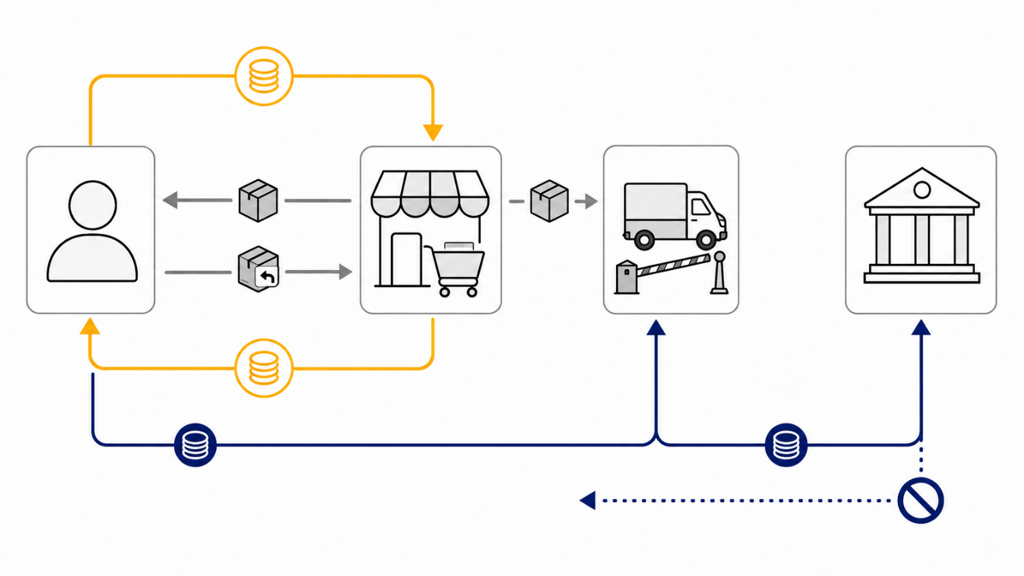
With the Incoterm Delivered at Place (DAP), you deliver to the destination, but the goods are imported into the European Union under your customer’s name. This causes a discrepancy in the cash flow when a return occurs:
-
The customer pays you the purchase price in the store.
-
Upon delivery, they also pay the shipping carrier the import sales tax and any customs duties that the carrier has advanced.
-
The customer returns the goods, and you refund the purchase price to them.
-
The import VAT remains with the government—it never passed through your account.
The conflict: Your customer is demanding a refund for money you never received—and the government will only reimburse it after a formal procedure.
Who is responsible for what in the DAP model?
Seller: Delivery to the destination
You are responsible for transportation, risk, and export from Switzerland. Your obligations end when the goods are ready for unloading at the destination—import customs clearance and import duties are not included. Our article on the Incoterms DDP and DAP explains the difference between DAP and Delivered Duty Paid (DDP).
Buyer: Importer with its own tax liability
If your customer is personally liable for the import duties, they are generally eligible to file a claim. They can file the refund claim themselves or—to the extent permitted by the relevant procedure—through an authorized representative, such as a customs broker or freight forwarder.
Transport Service Provider: Customs Clearance on Behalf of the Recipient and Advance Payment of Duties
The service provider declares the shipment for release into free circulation on behalf of the consignee and advances the duties, usually in exchange for a commission. The service provider is a service provider in the procedure, not a liable party—and is therefore not responsible for a refund.
The Three Ways to Obtain a Refund of Import Value-Added Tax
If imported goods are rejected and re-exported, European Union customs law provides for a refund—in three ways.
Method 1: Application to the competent customs office
or waiver. In the case of rejected, defective, or non-conforming goods, proof of the requirements and re-export must be provided. In Germany, Form 0223 can be used for this purpose; for a refund under Article 118 of the UCC, Form 0235 is also required. The application must generally be filed within one year of notification of the customs debt. Procedures, forms, and jurisdictions vary by Member State.
Option 2: Application via the freight forwarder
Some service providers handle the procedure on behalf of the recipient—though this is neither automatic nor free of charge: processing fees and minimum amounts are common. Clarify in advance whether your service provider offers this service in your target markets.
Option 3: Input Tax Credit for Business Customers
If the recipient is a business subject to VAT in the European Union, they can usually claim the import VAT as input tax—the simplest method, but only for business-to-business transactions.
What the buyer specifically needs for this
A refund application is a document-based process: If any supporting documentation is missing, the application will be rejected without a substantive review. The following are required:
-
Proof of re-export, such as a customs exit stamp.
-
The original or a certified copy of the import customs declaration.
-
Proof of identity, i.e., that the exported and imported goods are the same.
-
Return receipt and proof of rejection.
-
Compliance with the application deadline, which is typically twelve months.
Practical Note: Success depends on the return shipment
If the return shipment is sent back without proper proof of export or re-export, a subsequent refund request may be denied. In addition to the customs exit stamp, alternative forms of proof may also be accepted, depending on the procedure. Therefore, define the return process in advance with your logistics partner.
About the outbound process: Customs clearance in cross-border e-commerce.
Practical Note: Success depends on the return shipment
If the return shipment is sent back without proper proof of export or re-export, a subsequent refund request may be denied. In addition to the customs exit stamp, alternative forms of proof may also be accepted, depending on the procedure. Therefore, define the return process in advance with your logistics partner.
About the outbound process: Customs clearance in cross-border e-commerce.
Why this rarely works in practice
Legally, the process is feasible, but in practice it regularly fails—for four reasons:
-
Effort versus return: No one goes through a bureaucratic process for 40 euros in taxes.
-
Language: The application is submitted to the national customs authority in the destination country—in that country’s language.
-
Missing documents: The supporting documents are scattered among the transportation provider, the retailer, and the customer.
-
Time: It often takes weeks or even months from the time the application is submitted until the refund is paid out.
The result affects you: Your customer perceives the lack of a refund as your problem. A properly processed return turns into a bad review—especially when tax amounts reach four figures.
The Solution: IOSS or DDP from the Start
The most effective solution lies before shipment: Two models relieve your customer of the tax burden.
IOSS: The Solution for Shipments Up to 150 Euros
With the Import One-Stop-Shop (IOSS), you collect VAT at checkout and remit it centrally. Your customer pays nothing upon delivery; if they return the item, you refund them the gross amount—the transaction remains in your system. The key factor is the value threshold: The procedure applies exclusively to goods valued at up to 150 euros, and as a Swiss shipper, you need an intermediary based in the European Union. See the article on OSS and IOSS in Swiss e-commerce for details.
DDP: The Option for Higher-Value Shipments
IOSS does not apply to shipments with a value exceeding 150 euros. In this case, DDP is the standard: You handle import customs clearance and import duties, and your customer pays nothing at the doorstep. This makes the final price fixed and saves them a trip to the authorities.
Important: DDP does not automatically solve the returns problem
Even under the DDP model, the import VAT paid cannot be easily recovered in the event of a return. The difference: The process goes through you, not your customer. You reimburse them the gross amount and initially cover the difference yourself—the customer relationship remains intact.
Whether you can reclaim the taxes yourself depends on the procedure, the member state, and your registration.
Important: DDP does not automatically solve the returns problem
Even under the DDP model, the import VAT paid cannot be easily recovered in the event of a return. The difference: The process goes through you, not your customer. You reimburse them the gross amount and initially cover the difference yourself—the customer relationship remains intact.
Whether you can reclaim the taxes yourself depends on the procedure, the member state, and your registration.
Additional Level: The Tax Representative
A fiscal representative represents you, as a foreign seller, for tax purposes in an EU member state. Combined with your own VAT registration, the import VAT can be claimed as input tax. Whether this is worthwhile depends on volume, target markets, and the return rate.
Swiss Post provides advice on process and logistics; tax assessment is the responsibility of a specialized tax advisor.
Additional Level: The Tax Representative
A fiscal representative represents you, as a foreign seller, for tax purposes in an EU member state. Combined with your own VAT registration, the import VAT can be claimed as input tax. Whether this is worthwhile depends on volume, target markets, and the return rate.
Swiss Post provides advice on process and logistics; tax assessment is the responsibility of a specialized tax advisor.
Comparing DAP, DDP, and IOSS from the Customer’s Perspective
From the customer’s perspective, one question matters: Who takes care of the duties?
|
Criterion |
DAP without IOSS |
DDP |
IOSS (up to 150 euros) |
|
Who pays the import VAT? |
Customer upon delivery |
You, as the sender |
You, at checkout |
|
Unexpected costs at your doorstep |
Yes |
No |
No |
|
Applicable up to a shipment value of |
No value limit |
No value limit |
Only up to 150 euros in material value |
|
Refund in case of a return |
The customer applies directly to customs |
You reimburse the gross amount |
You reimburse the gross amount |
|
Effort required by the customer |
Application, supporting documents, deadlines |
None |
None |
|
Risk to the customer relationship |
High |
Low |
Low |
What You Can Do If the Damage Has Already Been Done
If the situation has already occurred, speed and clarity are key:
-
Prepare a customer service script: two sentences explaining that the import tax went to the government and not to you, plus a specific next step. What upsets customers isn’t the legal situation, but an evasive response.
-
Proactively obtain the documents: send the customer, without being asked, proof of return shipment, the dispatch note, and a copy of the import customs declaration.
-
Calculate the cost of a goodwill refund: For high-value shipments, it’s often cheaper than losing a regular customer.
-
Correct the setup: Goodwill gestures don’t solve structural problems—if the issue recurs, the shipping model needs to be reevaluated.
Conclusion
Under the DAP model, your customer pays the import VAT—and is left to bear the cost in the event of a return if they do not complete the refund process themselves and within the deadline. Legally correct, but commercially costly.
If you regularly ship to the European Union, it’s better to decide before shipping: IOSS for goods valued up to 150 euros, DDP for amounts above that. Both shift the processing to you and your logistics partner—rather than to your customer at the customs counter. Our white paper on EU customs clearance provides an overview.
Frequently Asked Questions About DAP Shipping Without IOSS
Who is liable for import sales tax under the DAP model?
The recipient. Under DAP, the recipient is considered the importer for customs purposes and is liable for import VAT and customs duties. The seller covers transportation and export duties, but not import duties.
As a merchant, can I claim a refund of the import VAT on behalf of my customer?
Generally, no. Only the party liable for the duties is eligible to file a claim—in the DAP model, that’s your customer. You can assist them by obtaining the necessary documentation or by acting on their behalf with a power of attorney.
How long does the buyer have to file a refund claim?
Generally, one year from the date the customs debt is notified. The exact deadline and procedure depend on the laws of the importing Member State, so it’s worth clarifying this with the relevant customs office as early as possible.
Does IOSS also apply to shipments over 150 euros?
No. The procedure applies exclusively to shipments with a value of up to 150 euros. Above that amount, the import must be cleared through customs in the regular manner, either under DAP or DDP.
Does DDP automatically resolve the VAT issue for returns?
No. Even with DDP, the import VAT already paid cannot be automatically refunded in the event of a return. The advantage is that the tax liability is handled through you, and your customer receives the full gross amount back from you.
What is the role of a fiscal representative?
A fiscal representative acts on behalf of a foreign shipper in tax matters before the authorities of an EU member state. Together with a VAT registration, they can facilitate input tax credits. Whether this makes sense in a specific case should be assessed by a tax advisor.
What is the most common reason why refund claims fail?
Lack of proof of re-export. If the return is sent back as a standard package, no customs exit stamp is issued—and without this documentation, the application is formally rejected.
Bibliography
- German Customs Administration: Remission and Refund of Import Duties – Procedures, Applications, and Deadlines.
- German Customs Administration: Rejection of Goods by the Importer (Articles 116–119 of the Union Customs Code).
- German Customs Administration: Documentation Required for Re-export Without Customs Supervision (Art. 180 of the Implementing Regulation).
- European Commission: One-Stop Shop – Import Rules for Distance Sales of Imported Goods Up to 150 Euros.
- Federal Office for Customs and Border Security (BAZG): Refund of Import Duties upon Re-export.