AI-based customs tariff classification for international e-commerce: Determine customs tariff codes automatically and error-free
Table of contents
Why manual customs classification is becoming a bottleneck in e-commerce
Every product in cross-border trade requires a correct customs tariff number. Over 5,000 product groups in the World Customs Organization’s (WCO) Harmonized System, country-specific extensions down to the tenth digit, and constantly changing regulations make manual classification of e-commerce product ranges difficult to manage.
According to a survey by the German E-Commerce and Distance Selling Trade Association (bevh), gross sales in the German online retail sector reached over 80 billion euros in 2024—with a growing share of that coming from cross-border trade. At the same time, the EU’s Import Control System 2 (ICS2) is tightening requirements for complete and accurate advance data, which includes the customs tariff number. For e-commerce retailers with hundreds or thousands of SKUs, manual tariff classification is simply no longer economically viable.
We explain in detail how tariff codes, product data, and shipping processes interact in international e-commerce in our guide to shipping packages abroad.
What is a customs tariff number and why is it mandatory for online retailers?
The customs tariff number is an internationally standardized numerical code that uniquely classifies every product in cross-border trade. It determines which customs duty rate applies, which import regulations are in effect, and whether special permits are required.
For e-commerce merchants, it is a mandatory requirement for every customs declaration—without the correct tariff code, no package can clear customs.
How is the customs tariff number structured—from the HS code to the TARIC?
The foundation of every customs tariff number is the HS code (Harmonized System Code), administered by the World Customs Organization (WCO). Over 200 countries and economic regions use the Harmonized System, which covers approximately 98 percent of international trade in goods.
The first six digits of the HS code are uniform worldwide – from the seventh digit onward, it becomes country-specific.
.jpg?width=3200&height=1460&name=Anatomie_Zolltarifnummer_EN%20(1).jpg)
As Swiss Global Enterprise explains in its export guide, every classification begins with the six-digit HS code. Building on this, the EU adds two digits to the Combined Nomenclature (CN) for statistical and trade policy purposes, and two additional digits to the TARIC for specific EU measures such as anti-dumping duties or import quotas.
For an e-commerce retailer who, for example, imports cotton T-shirts from Asia into the EU, this means in concrete terms: The HS code 6109.10 identifies the product worldwide as a “cotton T-shirt.” The TARIC code 6109.10.00.10 then determines the exact EU tariff rate of 12 percent and indicates whether additional trade measures apply.
A deviation of just one digit can result in a completely different tariff rate and different import regulations.
How do I find the correct tariff code for my products?
The correct classification of a good in the customs tariff follows a set of fixed rules: the General Rules (GR 1–6) for the interpretation of the Harmonized System. According to the General Customs Directorate, these six rules form the binding basis for every tariff decision.
The traditional manual approach involves using the Electronic Customs Tariff (EZT-Online) or the EU Commission’s TARIC consultation. This works for a range of 50 products—but with 5,000 SKUs, which are not uncommon in e-commerce, manual searching becomes an operational bottleneck.
On top of that, the Combined Nomenclature is updated annually. To provide additional legal certainty, customs authorities offer the Binding Tariff Ruling (vZTA), which is valid for three years in the EU—however, applying for it takes several weeks and is hardly compatible with the speed at which e-commerce product ranges expand.
Why is manual customs tariff classification so challenging in e-commerce?
Customs classification in e-commerce is complex because three factors come into play simultaneously: rapidly growing product ranges with thousands of SKUs, country-specific tariff differences starting from the seventh digit of the code, and a regulatory environment that is constantly tightening with ICS2, CBAM, and annual nomenclature updates.
Manual classification is no longer scalable in this environment. According to an analysis by Deloitte, the average error rate for manual customs classification ranges between 10 and 30 percent, depending on product complexity.
What penalties apply for an incorrect tariff code?
Financial back payments. If customs authorities determine during an audit that goods have been incorrectly classified over an extended period, the underpaid customs duties will be retroactively collected—up to three years back. With an annual import volume of 2 million euros and a customs duty difference of just 3 percent, this amounts to 180,000 euros.
Operational delays. According to Hurricane Commerce, incorrect customs data caused a hold rate of over 30 percent of all cross-border shipments at a logistics partner during the 2021 peak season. After introducing a data-driven classification solution, this rate dropped to under 0.5 percent.
Fines and sanctions. In Germany, according to the German Fiscal Code (§ 378 AO), negligent tax evasion in the customs sector can be punished with fines of up to 50,000 euros per case. Systematic violations also risk the revocation of AEO status.
The most common cause of customs reassessments is not unintentional misdeclarations, but simply outdated or never systematically checked tariff codes in the master data.
The most common cause of customs reassessments is not unintentional misdeclarations, but simply outdated or never systematically checked tariff codes in the master data.
Why are customs data requirements increasing in e-commerce?
ICS2 (Import Control System 2). Since its full rollout, the European Commission has required complete electronic advance data for all shipments, including a valid six-digit HS code and a precise description of the goods.
CBAM (Carbon Border Adjustment Mechanism). The EU’s Carbon Border Adjustment Mechanism links the tariff code for the first time to the carbon footprint of specific product groups. The tariff code is increasingly becoming the data anchor for compliance requirements beyond traditional customs duties.
Annual nomenclature updates. The World Customs Organization (WCO) fundamentally revises the Harmonized System every five years—the next revision (HS 2027) is already in preparation. According to Mendel Verlag, the annual changes regularly affect several hundred subheadings.
How does AI-based customs classification work, step by step?
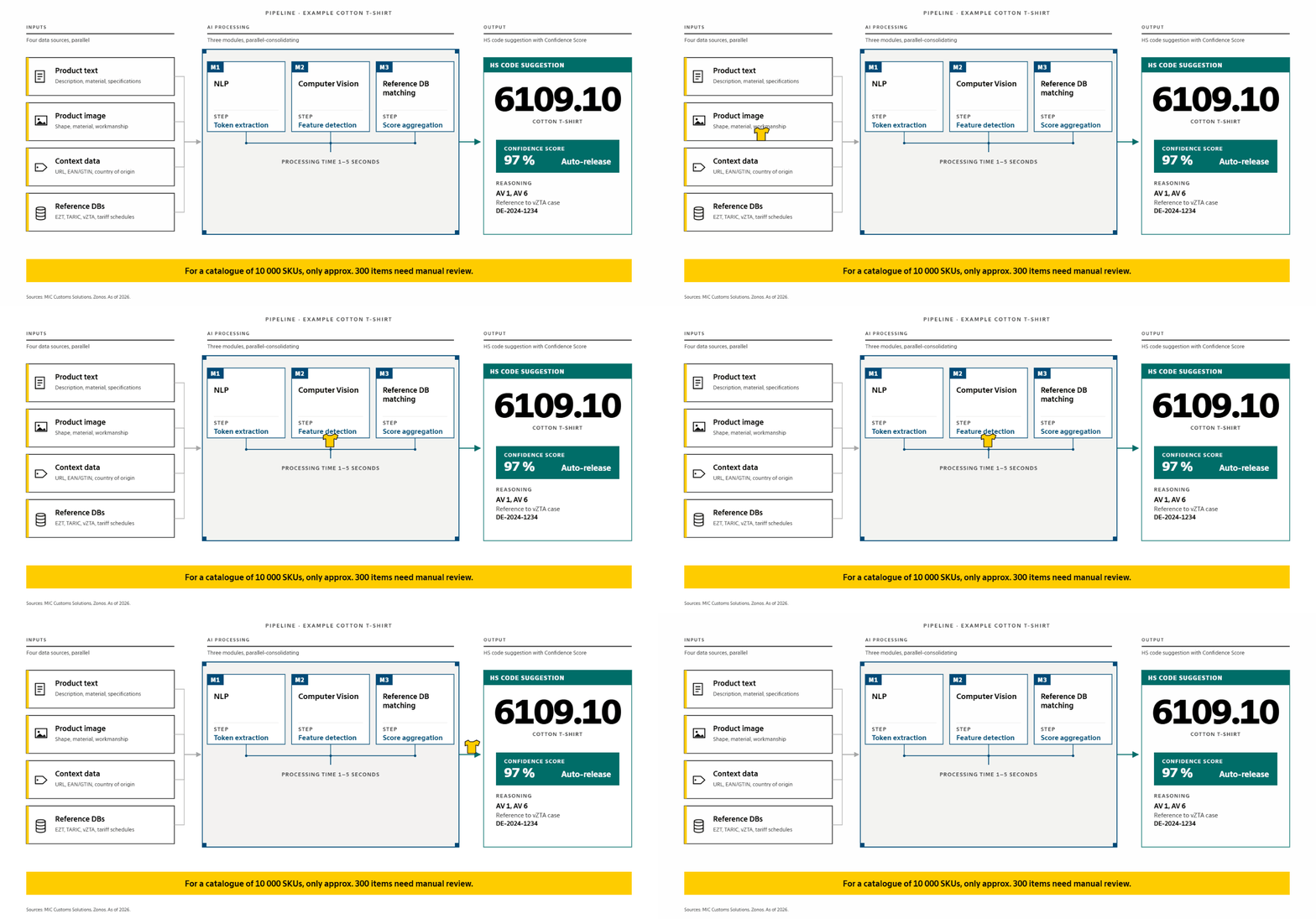
AI-based tariff classification analyzes product data—descriptions, technical specifications, and images—using natural language processing (NLP) and computer vision, automatically matches it against official tariff databases, and provides a reasoned recommendation for the correct tariff code, including a confidence score. The entire process typically takes just a few seconds per item.
According to MIC, a provider of trade compliance software, the average processing time per classification case was reduced by 71 percent through the use of their AI Classifier.
What data does the AI need to determine the correct tariff code?
Text-based product data. Product name, description, material details, intended use, and technical specifications. The NLP component extracts the classification-relevant features from this data.
Product images. Computer vision analyzes visual characteristics—shape, material, and type of construction. A product photo tells the AI whether it is a textile backpack (HS 4202.92) or a leather backpack (HS 4202.91).
Additional contextual data. URLs, EAN/GTIN codes, category assignments, and country of origin. Multimodal AI systems today accept inputs from Excel files, ERP exports, and URL imports.
Reference databases. In the background, the AI compares each suggestion against the EZT, TARIC, vZTA/EBTI, and country-specific tariff schedules.
What does the Confidence Score mean in AI tariff classification?
The Confidence Score indicates, on a scale from 0 to 100 percent, how certain the system is about its suggestion. According to MIC, their AI Classifier provides the correct tariff code for 97 percent of classified items.
For a catalog of 10,000 SKUs, only about 300 items would need to be manually verified.
The AI doesn’t just provide a code, but a transparent justification based on the General Rules—including references to vZTA precedent cases.
The AI doesn’t just provide a code, but a transparent justification based on the General Rules—including references to vZTA precedent cases.
What advantages does AI-based customs tariff classification offer over manual classification?
AI-based customs tariff classification outperforms manual classification in four key areas: speed, scalability, consistency, and traceability. It does not replace human expertise, but rather shifts it to the cases where it is truly needed.
|
Criterion |
Manual Tariff Classification |
AI-based classification |
|
Speed |
15–45 min. per item |
1–5 seconds |
|
Scalability |
Linear – same effort |
Bulk classification of entire catalogs |
|
Consistency |
Depends on the user |
Identical input = identical result |
|
Accuracy |
70–90% |
90–97% |
|
Audit trail |
Often incomplete |
Automatic: Reason + Score |
|
Regular updates |
Manual reconciliation |
Automatic update |
|
Cost per item |
15–50 EUR |
0.05–2.00 EUR |
|
Availability |
Office hours |
24/7, API-based |
According to McKinsey, AI-powered automation solutions in trade compliance can reduce operational costs by 30 to 50 percent.
Can AI-based customs tariff classification replace customs consultants?
No—and that’s not the goal. About 70 to 80 percent of all tariff classification cases in e-commerce involve standard products, which AI handles reliably. The remaining 20 to 30 percent require human expertise.
The model that is gaining traction is a three-step workflow: automatic classification, rule-based approval, and manual review for cases with a low confidence score.
How does AI automate customs declarations in online stores?
Modern solutions offer API interfaces for Shopify, WooCommerce, Magento, SAP Business One, and Microsoft Dynamics. With “Classify on the Fly,” Zonos offers a solution that returns a country-specific HS code in real time at checkout—the basis for a Delivered Duty Paid (DDP) model with a transparent final price.
What should online retailers look for when choosing an AI customs classification solution?
Choosing the right solution depends on five key criteria: classification accuracy and transparency, country support, integration capabilities, scalability of the pricing model, and automatic regulatory updates.
Criterion 1 – Accuracy and traceability. It is crucial that the system can justify its suggestions according to the General Rules (GRS 1–6) and validate them against vZTA reference cases.
Criterion 2 – Country support and tariff systems. For DACH merchants, at least Tares (CH), TARIC (EU), UK Trade Tariff (HMRC), and HTS (USA). Zonos Classify supports nearly 200 countries.
Criterion 3 – Integration with existing systems. API interfaces and native integrations with Shopify, WooCommerce, Magento, SAP, and Oracle.
Criterion 4 – Pricing model and scalability. From pay-per-query (starting at 0.50 EUR) to monthly packages (99–499 EUR) to Enterprise SaaS (starting at 500 EUR/month).
Criterion 5 – Automatic updates. CN code changes, tariff updates, and new regulations must be automatically integrated.
|
Pricing Model |
Typical providers |
Suitable for |
Price range |
|
Pay-per-query |
zolltarifnummer.com, TariffPilot |
Small retailers |
0.50–3.00 EUR/query |
|
Monthly package |
traide.ai, noknots |
Medium-sized retailers |
99–499 EUR/month |
|
Volume-based SaaS |
Zonos, Avalara, Hurricane |
Large retailers, 3PLs |
Starting at approx. 500 EUR/month |
|
Enterprise / Custom |
AEB, MIC, Digicust |
Corporations, freight forwarders |
Starting at approx. 1,000 EUR/month |
How much does AI-based customs tariff classification cost?
Calculation example for 3,000 SKUs + 200 new items/month: Manual full classification costs approx. 64,000 EUR/year. AI + manual residual review: approx. 6,400 EUR/year.
Savings: around 57,600 EUR per year – a factor of 10.
What changes are coming in 2026 for customs tariff classification in e-commerce?
The regulatory environment will tighten in 2026 on three fronts simultaneously: ICS2 requires complete electronic pre-clearance data, CBAM expands the role of the customs tariff code to include an emissions dimension, and the updated Combined Nomenclature requires a systematic review of existing classifications.
What does ICS2 mean for online retailers in concrete terms?
Every Entry Summary Declaration (ENS) must contain a valid HS code at a minimum six-digit level. Generic descriptions such as “gift” or “clothing” will be systematically rejected.
According to E-Commerce Europe, ICS2 increases the data requirements per shipment by 30 to 40 percent.
You can find more information on specific customs changes starting in 2026 in our blog article on the 2026 EU customs reform and the new TPC fee for shipments to France under 150 EUR.
What role does CBAM play in product classification?
CBAM will enter its final phase starting in January 2026. Affected product groups: iron/steel, aluminum, cement, fertilizers, hydrogen, electricity.
The EPRS is discussing plastics and organic chemicals as candidates for the next round of expansion. The EU Deforestation Regulation (EUDR) also uses the customs tariff code to identify affected goods.
What does the updated Combined Nomenclature 2026 mean?
The CN is updated annually via an implementing regulation. Existing tariff codes can become invalid overnight.
AI-based solutions automatically reconcile the entire product catalog against the new nomenclature.
The combination of ICS2 data requirements, CBAM reporting obligations, and annual nomenclature updates creates a level of compliance complexity that is no longer manageable without automation.
The combination of ICS2 data requirements, CBAM reporting obligations, and annual nomenclature updates creates a level of compliance complexity that is no longer manageable without automation.
Conclusion: AI-based tariff classification as a strategic lever
AI-based customs tariff classification is no longer a future scenario—it is an operational lever that gives e-commerce retailers a measurable competitive advantage.
Those who automate the determination of tariff codes reduce costs by up to 90 percent, lower error rates to below 5 percent, and prepare their companies for ICS2, CBAM, and annual nomenclature updates.
Key takeaways
- The customs tariff code is mandatory, not optional—misclassifications lead to back payments, fines, and delays.
- Manual tariff classification does not scale—it is structurally overwhelmed by thousands of SKUs and changing regulations.
- AI classifies in seconds instead of hours—using NLP, computer vision, and official reference databases.
- Humans and AI complement each other—70–80% of standard cases are handled automatically, while complex cases are referred to customs experts.
- The right solution must fit your business model – consider these 5 selection criteria.
- By 2026, the regulatory environment will become even more challenging – ICS2, CBAM, Combined Nomenclature.
Your next step: Test AI-based customs tariff classification with your own product catalog and calculate the ROI. Most providers—including Zonos, traide.ai, and zolltarifnummer.com—offer free trial periods.
Bibliography
-
European Commission – Taxation and Customs Union: Import Control System 2 (ICS2).
-
World Customs Organization (WCO): What is the Harmonized System (HS)?
-
Switzerland Global Enterprise (S-GE): Tarifierung und Zollsätze – Exportwissen für Schweizer KMU.
-
Bundesministerium der Justiz: § 378 Abgabenordnung (AO) – Leichtfertige Steuerverkürzung.
-
Zonos: Automate HS Code Classification with Zonos Classify (Dokumentation).
-
Zonos: HS Code Auto-Classification: Classify on the Fly (Dokumentation).
-
traide AI: KI-gestützte zollrechtliche Stammdaten und HS-Code-Klassifizierung.
-
TariffPilot: KI-gestützte Plattform für HS-Code-Klassifizierung und Trade Compliance.
-
Avalara: Tariff Code Classification – HS-/HTS-Code-Klassifizierung mit KI.