International shipping – Your comprehensive guide to sending packages abroad
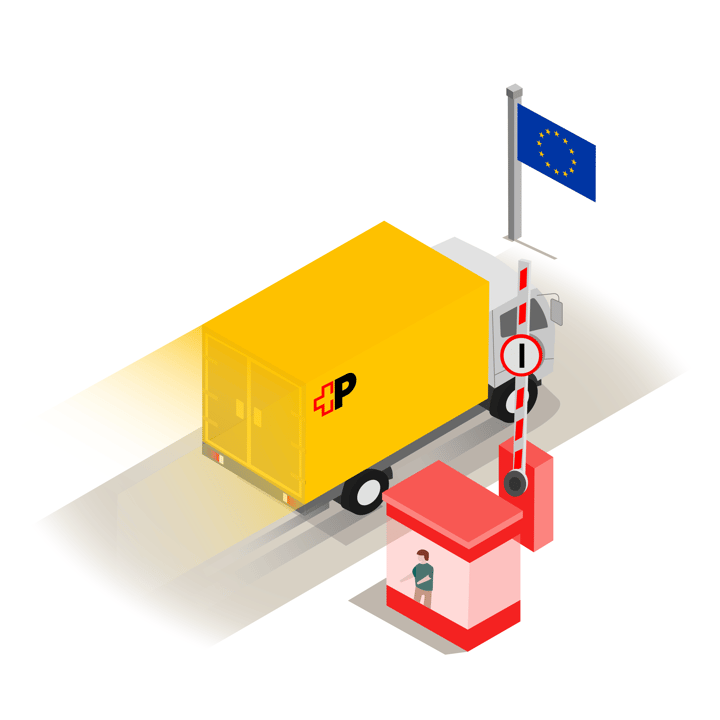
Table of contents
Why international shipping opens up opportunities
Export is a growth driver. You can reach new target groups, spread risks across multiple markets, and make better use of your product range. The figures speak for themselves: the German e-commerce market achieved a turnover of around €80 billion in 2024 and continues to grow. The HDE even forecasts over €92 billion for 2025. In France, e-commerce sales are around €150 billion, while Italy is recording double-digit growth. These are markets right on your doorstep – and international shipping opens the door to them.
The challenge: customer expectations are high everywhere. Consumers compare globally. They also expect a smooth experience when making cross-border purchases. That means clear total costs, transparent delivery times, traceable tracking, and easy returns. As soon as there is a lack of transparency somewhere, trust declines. And trust is the currency that is most quickly lost abroad.
International shipping is therefore not purely a logistics issue. It is a combination of strategy, law, data, process design, and communication. If you set it up well, export becomes predictable. If you do it on the side, it becomes expensive: through support costs, returns, refusals to accept delivery, and negative reviews.
Basics: What is changing for shipping from Switzerland
As soon as you send packages from Switzerland to other countries, three issues automatically come up.
Customs clearance
Your goods are imported into the destination country. Customs wants to know what is in the package, how much it is worth, and how it is classified. Without this information, your shipment will be held up or cause delays.
Taxes and duties
Depending on the destination country, import VAT and, in some cases, customs duties may apply. Import VAT is 19 percent in Germany, 20 percent in France, 22 percent in Italy, and 20 percent in Austria. In addition, there are often processing fees charged by service providers of between €10 and €25 per shipment. These costs are borne either by you or your customers, depending on the shipping model.
Documents and data quality
Without correct data, everything slows down and becomes more prone to errors. You need clear product descriptions, correct values, weight specifications, and ideally HS codes for your products.
Important terms you should know
Incoterms are international delivery terms. They define who bears which costs and risks.
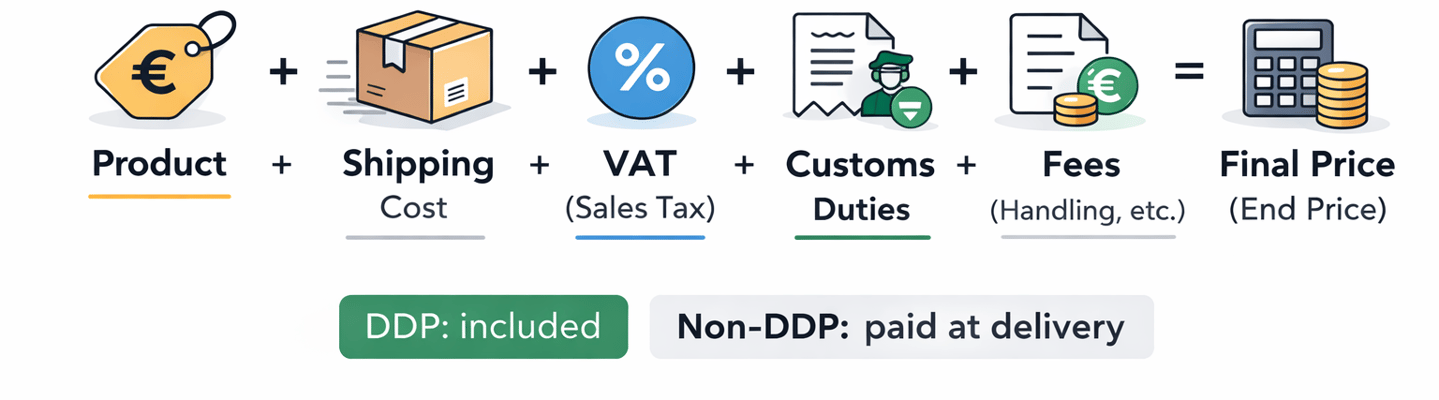
Two models are particularly relevant for e-commerce. With non-DDP (often referred to as DAP), the recipient pays import duties in the destination country. With DDP, you pay the duties and organize the process so that recipients don't experience any surprises.
Total landed cost is the total amount that customers actually pay: product price plus shipping plus taxes plus fees. Making this amount transparent reduces frustration and support requests.
The HS code is an internationally standardized customs tariff number. It helps to calculate duties correctly and reduces queries from customs authorities. The first six digits are uniform worldwide.
The commercial invoice is a standard document for customs. It describes the contents, value, and other details. Even though much of the process is now digital, a clear invoice remains the linchpin.
Market selection: How to decide where to start
A common mistake: You activate 20 countries in your shop, set a flat delivery time, and hope that everything will work out. This may seem like growth, but it mainly creates complexity and support costs.
A focused start is better. Choose one or two countries, set them up properly, test and improve your processes. Only then should you roll out to other markets. This way, you'll learn quickly without getting bogged down.
Europe as the primary market
For Swiss SMEs, Europe is the most sensible place to start. Distances are short, delivery times are predictable, and many customers are used to cross-border purchases.
Germany is the largest e-commerce market in Europe. The top 1,000 online shops generated around €80 billion in net sales in 2024. Demand for Swiss products is high, especially in the areas of quality, sustainability, and premium goods. The largest product groups are clothing and electronics. France follows with an e-commerce market of over €150 billion and a growing cross-border share. Italy is seeing double-digit growth in online retail. Austria is linguistically and culturally close and is an excellent test market with lower risk.
UK as a secondary market
The United Kingdom is attractive, but has become more complex since Brexit. The most important rules: For shipments with a value of up to £135, UK VAT of 20 percent is levied at the point of sale, not on import. This means that you must register for a UK VAT number and calculate and pay the tax at checkout.
Shipments over £135 are subject to standard import VAT and, if applicable, customs duties at border clearance. You need a separate UK EORI number for customs declarations.
Important: The £135 threshold refers to the intrinsic value of the goods without shipping costs and insurance. From 2029, the UK government plans to end duty-free imports below this threshold, which would mean additional duties.
If you are stable in the EU, you can tackle the UK as the next step. Plan your own resources and separate processes for this.
Your market selection checklist
Evaluate these points for each country:
Demand and product range fit: Is there demand for your product category? Is your price level appropriate? Are there any cultural peculiarities such as sizing systems or payment preferences?
Economic efficiency: How high is your margin per order? How high are shipping costs for different weight categories? How often do returns occur?
Operational feasibility: Can your support team answer inquiries in the local language? Can your shop display the most important information clearly? Is your master data good enough?
Risk and complexity: Are there product rules or restrictions? Is your product range subject to customs restrictions, for example, certain electronics or branded products?
If you decide based on this logic, it may not be perfect. But it is conscious. And conscious means you can control it.
International shipping: Shipping methods and cost models
Many SMEs waste margin because they are too quick to send everything as a parcel. The difference between letter and parcel logic is often the biggest cost lever – especially if you regularly handle international shipments.
International merchandise mail vs. parcels: the most important adjustment
If you want to send parcels internationally, you should first check whether an international goods shipment would not be cheaper. Letters, small goods shipments, and products such as international goods mail are a good choice if your items are light and compact, you use standardized packaging, and you have many similar shipments. Parcel shipping makes sense if the weight and dimensions increase, you have higher goods values, or your products are fragile.
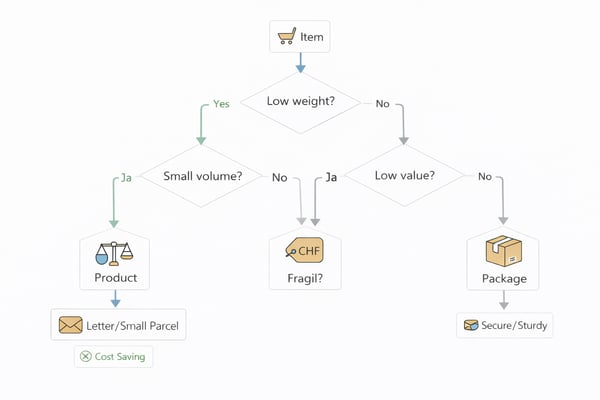 Your goal: a clear set of rules governing which product falls under which shipping method. And a packaging strategy that actively optimizes weight and volume.
Three proven cost models
You need a model that customers understand and that protects your margin.
Option one is a flat rate per country or zone. The advantage: quick and easy to implement. The disadvantage: you pay for outliers such as heavy or bulky shipments yourself.
Option two is weight scales. The advantage: realistic and scalable. The disadvantage: you need good master data and clean packaging processes.
Option three is dynamic calculation including total landed cost. The advantage: maximum transparency and fewer surprises. The disadvantage: more setup effort.
A concrete example: you sell T-shirts with an average weight of 250 grams when packaged. For Germany, you could offer a flat rate of 8 francs for shipments up to 500 grams. With a VAT rate of 19 percent and a product price of 45 francs, the import VAT is around 8.50 euros. If you offer DDP, you include these costs in your checkout price. If you do not offer DDP, you clearly inform your customers that approximately 10–15 euros may be payable upon delivery. Anyone who compares international parcel post prices with traditional parcel rates will quickly realize that the small goods logic saves a lot of money for light shipments.
Set realistic delivery times
Delivery time is not just transport time. International shipping also involves processing time in the warehouse, customs clearance, and transfers between networks. For EU countries, allow 3–7 business days for standard shipping. Set delivery times that you can meet. An overly optimistic promise does you more harm than good abroad.
DDP vs. non-DDP: How to choose the right model
The decision between DDP and non-DDP is central to your customer experience and your cost structure. Studies show that unexpected shipping costs are one of the main reasons for shopping cart abandonment in cross-border e-commerce.
Non-DDP: Customers pay in the destination country
With non-DDP, import VAT and, if applicable, customs duties are payable in the destination country. Recipients must pay upon delivery, pay extra via a payment link, or bear additional processing fees. In Germany, these handling fees typically range between $10 and $28.
This is legally normal, but often frustrating from the customer's point of view. Many perceive it as a hidden cost, even if you mention it somewhere. The consequences: higher checkout abandonment rates, more refusals to accept delivery, increased support costs, and poorer reviews.
Non-DDP can still make sense if you only export sporadically, are in a niche where customers accept import duties, sell high-priced products to a premium audience, or want to start small. But then it's crucial that you communicate this extremely clearly.
DDP: You take away the uncertainty for your customers
DDP means: You pay the duties and organize the process so that customers do not have to make any additional payments. This makes purchasing easier and builds trust.
The advantages are measurable: higher conversion at checkout because customers are certain about the final price. Fewer support tickets regarding customs and additional payments. Significantly fewer refusals to accept delivery. And a better brand experience because you are perceived as professional.
Practical example: Sneaker shop reduces support costs with DDP
A Swiss sneaker store switched to DDP for Germany and reduced support tickets by 35 percent within two months. Refusals dropped from 8 percent to less than 2 percent.
Practical example: Sneaker shop reduces support costs with DDP
A Swiss sneaker store switched to DDP for Germany and reduced support tickets by 35 percent within two months. Refusals dropped from 8 percent to less than 2 percent.
DDP is not just a price tag. It is a process. You need clear data, clean processing, and a logical way to calculate duties and display them at checkout.
Decision-making aid
DDP is often the better choice if you regularly deliver to the EU, your average shopping cart is low to medium (under 200 Swiss francs), your target group is price-sensitive, and you want to scale growth in a predictable manner. Non-DDP may be sufficient if you only have a few shipments per month, have a clear premium case with shopping carts over 500 Swiss francs, or are willing to accept surprises as learning costs.
Many shops start with non-DDP, learn quickly, and then switch to DDP for focus countries because it makes good business sense.
Unsure which model is right for you? Use our Optimizer and find the best option for your target markets in 5 minutes.
Customs, taxes, and compliance
This is what determines whether your export runs smoothly or whether you have to put out fires every day. Most problems arise not from complicated laws, but from poor data and unclear rules.
The three most common declaration errors
Error one: unclear description of goods. Terms such as “accessories,” “parts,” or “gift” do not help customs. Use clear descriptions with material, purpose, and product type. Instead of “fashion item,” write “women's T-shirt, 100% cotton, short sleeves.”
Mistake two: incorrect value of goods. Discounts, bundles, or promotions must be clearly stated. The declared value must correspond to the actual sales price. Unrealistic values lead to queries or incorrect duties.
Mistake three: incomplete documents. If information is missing or does not match, the chance of shipments being held up increases. The label and invoice must match.
Master data as insurance
If you invest in only one thing, invest in master data. It is the basis for correct declarations, correct duty calculations, stable automation, and fewer exceptions.
Minimum per item: weight and dimensions of the package, clear description of the goods in German and English, goods value logic including discount rules, product category such as textiles, electronics, or cosmetics. Optional but recommended: HS code and country of origin.
You can find the HS code online via the Swiss customs tariff Tares. Enter your product and note the first six digits. These are valid internationally. For a cotton T-shirt, for example, this would be 6109.10.
Import VAT at a glance
The standard VAT rates are crucial for your calculation: Germany 19 percent, France 20 percent, Italy 22 percent, Austria 20 percent, UK 20 percent. Reduced rates apply to certain product groups such as food or books.
Clarify restrictions early on
Some products are subject to special regulations for international shipping. Typical examples: Electronics with lithium batteries require special labeling and documentation. Products containing liquids or pressurized containers are subject to quantity restrictions. Cosmetics and health-related products often require additional documentation. Items that are sensitive in terms of trademark law may be held up at customs.
If you are dealing with such categories, define a clear internal checklist before a product is approved for export. Keep a stop list for products that you do not export. Establish an escalation path to determine who makes the decision when it is unclear.
Checklist for your master data? Download now and close the gaps.
Customer-oriented shipping: Communication and tracking
Exporting is always about customer experience. Your customers don't see your process. They see the order, costs, delivery time, updates, arrival, and returns.
Communication along the customer journey
Many problems arise because customers don't know what to expect.
Before the purchase: Show delivery times for each country, not just a general international time. Show shipping costs clearly and not hidden. Explain whether taxes and duties are included. Describe return policies with deadlines, costs, and procedures.
After the purchase: Send a confirmation with a tracking link. Briefly summarize the most important rules. Offer a support contact for questions.
During delivery: Confirm shipment. Inform customers of important status changes. Communicate proactively in case of delays and explain the next step.
A simple sentence can go a long way: “All duties are already included in the price. You pay nothing extra on delivery.” Or for non-DDP: "Upon import into your country, additional duties of approximately 15–20 euros may apply. " The key is that customers know this in good time.
Tracking as a building block of trust
Tracking is mandatory when sending parcels abroad. Not because it is technically impressive, but because it builds trust. Every status that customers can see for themselves is one less ticket in support.
Best practices: Include a tracking link in every email regarding the order and shipping. Make tracking prominent in the customer account. Provide a brief explanation of what the most important statuses mean. Optionally, create a separate order status page that bundles all the information.
Manage returns professionally
Returns are one of the biggest cost drivers in cross-border e-commerce. The figures are clear: Germany has the highest return rate in Europe at 56 percent. In the fashion sector, return rates range from 26 to 50 percent, and in some cases even up to 75 percent. The average cost per return is between 15 and 25 euros when transport, handling, and depreciation are included.
At the same time, returns are a major reason why customers abroad do not buy when they are unsure. A clear returns policy can therefore increase conversion rates.
You need answers to three questions: Who pays for the return? How do customers get the label or instructions? What happens to the goods after they are received?
Practical logic for SMEs: Define a standard process for focus countries with as few exceptions as possible. Communicate it in three steps, not in legalese. Example: “1. Register the return in your customer account. 2. Print out the label and return the package with postage paid. 3. Refund within 5 business days of receipt.”
Set a profitability threshold: At what value of goods is return shipping worthwhile? For items under $20–30, it is often cheaper to offer a refund without return shipping.
Actively incorporate return reduction through better product information, size charts, videos, and FAQs. Studies show that detailed product information can reduce the return rate by up to 30 percent.
Practical example: Fit guides reduce return rates
A Zurich-based online fashion store introduced detailed fit guides with body measurements instead of just clothing sizes. The return rate for Germany fell from 42 to 31 percent within a quarter.
Practical example: Fit guides reduce return rates
A Zurich-based online fashion store introduced detailed fit guides with body measurements instead of just clothing sizes. The return rate for Germany fell from 42 to 31 percent within a quarter.
Processes and technology: How to scale without chaos
As soon as exports pick up, something typical happens: the process that somehow worked for five shipments per day becomes a problem when there are fifty shipments. Scaling requires standardization—whether you want to send a single international shipment or hundreds of packages abroad.
From individual cases to rules
The most important step toward scaling is a set of rules. Define: Which countries do you deliver to? Which shipping methods do you use depending on weight, dimensions, and value of goods? When do you use DDP, when do you use non-DDP? Which product groups are special cases? Which documents are standard?
Example of a simple set of rules: EU countries up to 2 kg and 150 Swiss francs in value use small goods shipping with DDP. EU countries over 2 kg or over 150 Swiss francs use parcel shipping with DDP. Products with batteries receive a special dangerous goods process. The UK receives a separate process with VAT registration.
Once these rules are defined, a smaller team can handle larger volumes because there is less discussion.
Automation with impact
Many shops automate label printing, but not the decision of which model to use. Yet it is precisely this decision that is the lever against errors.
Examples of automation rules: EU countries standard shipping up to two kilograms via small goods, above that via parcel. Goods value above a certain amount triggers additional inspection or insurance. Product category with battery triggers special shipping process with documentation. Countries with high return rates receive stricter communication before purchase.
Integration as a target vision
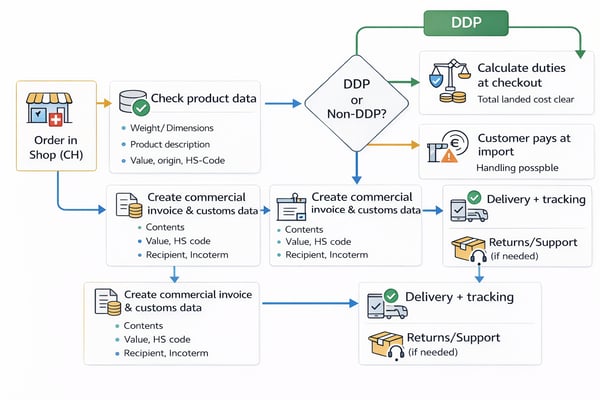
A stable process looks like this: Order in the shop leads to master data and rules, then to shipping label and documents, then to tracking, then to status updates, then to returns, then to reporting.
You don't have to build everything at once. Work towards it step by step: clean up master data, start with focus countries using a standard process, map rules in tools, expand automation, professionalize reporting.
Measure the right KPIs
If you manage exports, you need more than just shipping costs. Measure per country: delivery time as median and 90th percentile, not just average. Percentage of delays due to customs or duties. Refusals and undeliverable shipments. Support tickets per hundred orders. Return rate and return costs per shipment. Contribution margin per country including all costs. This will help you determine whether a country is truly profitable or just generating revenue.
Best practices by industry
The basic logic is always the same. But depending on the industry, there are typical patterns and proven solutions.
Fashion and lifestyle
Pain points: High return rate of 30 to 50 percent on average, many variations due to sizes and colors, price-sensitive customers who do not tolerate surprise costs.
Proven practices: Optimize packaging and weight to stay in the cheaper letter segment as often as possible. A T-shirt in a polybag instead of a cardboard box quickly saves 3–5 Swiss francs per shipment. Improve size charts with real body measurements and add fit guides with photos. Introduce transparent cost logic with DDP for focus countries. Make the returns process extremely simple and explain it in three steps.
Practical example: DDP and size advice increase conversion rates
A Basel-based underwear label introduced DDP to Germany and supplemented detailed size advice with comparisons to well-known brands. Conversion rates rose by 18 percent and returns fell by 25 percent.
Practical example: DDP and size advice increase conversion rates
A Basel-based underwear label introduced DDP to Germany and supplemented detailed size advice with comparisons to well-known brands. Conversion rates rose by 18 percent and returns fell by 25 percent.
Sports equipment
Pain points: Mix of small accessories and bulky items, seasonal peaks during winter sports or events, high expectations for delivery times before the season.
Best practices: Cluster products into compact and bulky categories and define separate shipping logic. Gloves and hats go as small items, ski boots as packages. Set conservative delivery times for bulky items and offer premium express options. Define packaging standards to control volume weight.
Electronics and accessories
Pain points: Compliance with rechargeable and non-rechargeable batteries, value declaration for high-priced items, warranty and support issues from abroad.
Best practices: Create clear product categories in the system, use “with battery” as a trigger for special processes with UN38.3 documentation. Very accurate product description with model number and technical data. Define clear rules for warranty claims abroad: What is a return, what is a replacement delivery, who bears the costs. Prepare support texts and FAQs in German and English.
Consumer goods and FMCG
Pain points: Limited margin per item, shipping costs quickly seem too high in relation to the value of the goods, customers expect the same speed as with local suppliers.
Best practices: Introduce bundles or minimum order values to stabilize the shopping cart at a minimum of 40–50 Swiss francs. Communicate extremely transparent total costs so that customers are not uncertain about repeat purchases. Standardized packaging and high process automation, because volume is the only lever for profitability.
Luxury goods
Pain points: Premium expectations for service and communication, high risk in case of loss or damage, customers do not tolerate gray areas or unprofessional handling.
Best practices: DDP-oriented experience for all focus countries, because it signals trust and professionalism. Proactive, personal communication and high-quality tracking experience with real-time updates. Stable, high-quality packaging with additional services such as signature on delivery and transport insurance. Very clear returns and warranty processes with a personal contact person.
Summary and next steps
International shipping will be successful if you treat it like a product: with strategy, standard processes, and clear communication. You don't have to perfect everything at once. You need a planable start and a clear path to optimization.
Your roadmap in five steps
Want to start exporting but don't know where to begin? These five steps will take you from plan to first delivery in a structured way.
- Choose your target market: Start where the hurdles are low. With over €90 billion, Germany offers the largest German-speaking e-commerce market. Austria and France are suitable as the next step.
- Set your pricing model: Opt for DDP (Delivered Duty Paid). Your customers will see the final price including customs duties and taxes directly at checkout – no surprises, fewer cancellations, higher conversion rates.
- Regulate customs and taxes: Clarify customs tariff numbers (HS codes) and VAT obligations in the destination country. For the UK market, you also need an EORI number and, for goods valued at less than £135, a UK VAT registration.
- Prepare master data and returns: Clean product data—weight, dimensions, country of origin—are the basis for smooth customs clearance. At the same time, plan your returns strategy: Return shipping to Switzerland or local warehouse?
- Connect logistics partners: Choose a partner that offers customs clearance, shipping, and tracking from a single source. Integration into your shop saves time and reduces errors.
Sources
- Switzerland Global Enterprise S-GE (s-ge.com): Customs Clearance for Imports and Exports.
- EHI Retail Institute & ECDB (2025): Germany’s E-Commerce Market 2025. Study on the Top 1,000 B2C Online Stores.
- German Retail Association (HDE) (2025): E-Commerce Sales and Forecasts.
- German E-Commerce and Mail-Order Trade Association (bevh) (2025): Interactive Commerce in Germany. 2024 Annual Report.
- EHI Retail Institute (2023): Shipping and Returns Management in E-Commerce. Study on Return Rates by Industry.
- UK Government, HMRC (2022): VAT and Overseas Goods Sold Directly to Customers in the UK.
/logistikpartner-wechsel-breit.png?width=1200&name=logistikpartner-wechsel-breit.png)