Payment methods & currencies in Switzerland: Guide to increasing your conversion in Swiss e-commerce
Table of contents
Payment habits in Switzerland
Why payment in Switzerland is different
Swiss customers are very experienced in online shopping. At the same time, their expectations regarding clarity are particularly high. This is particularly evident at checkout: as soon as something seems “unclear” (currency, additional costs, unfamiliar payment methods, lack of security signals), the number of abandoned transactions rises rapidly.
Three reasons why payment in Switzerland often works differently than in EU markets:
-
First, transparency is a sign of trust: Swiss customers want to understand early on what they are paying, in which currency, and whether there may be additional fees.
-
Second, local habits are strong: those who offer familiar Swiss payment methods immediately appear more “authentic” to the market.
-
Third, mobile usage is high: a checkout that runs quickly and smoothly on mobile devices is a direct conversion lever. The figures back this up: 52% of all online purchases in Switzerland are already made via smartphone, and 75% of online shoppers use shopping apps (increase since 2021). Mobile payments now account for 69.1% of all online transactions. So if you don't optimize your checkout for mobile, you're losing over half of your potential.
Trust and security as key factors
According to Swiss Payment Monitor, mobile payments are now the most widely used payment method in distance selling. Mobile payment is therefore a structural standard for online retail.
Payment is part of the customer experience. Trust is not created by big promises, but by small signals:
These include familiar payment logos in the right places (product page, shopping cart, checkout), clear billing texts (CHF, final price, refund), clean error handling without cryptic messages, and stable performance without reloading, detours, or unexplained failures.
If you want to scale in Switzerland, a simple principle is worth following: make the checkout as familiar as possible and as self-explanatory as possible.
Popular payment methods in Swiss e-commerce
The right choice of payment methods in Switzerland depends on your product range, target group, and price positioning. Nevertheless, there are clear standards – from TWINT payment options to invoicing and credit cards – that you should at least consider.
TWINT: The Swiss standard (especially mobile)
TWINT is extremely prevalent in Switzerland and is perceived by many customers as a fast, simple standard solution, especially when used on the go via the TWINT app. The conversion effect often arises less from “more choice” and more from the feeling that “this is made for me.”
The figures speak for themselves: TWINT has over 6 million users in Switzerland – linked to accounts with PostFinance, UBS, Raiffeisen, and other banks – and is the clear market leader with 66.7% of all mobile transactions. In distance selling, the share of TWINT payments is as high as 70.2%. This means that anyone who does not offer TWINT is effectively excluding two-thirds of mobile shoppers.
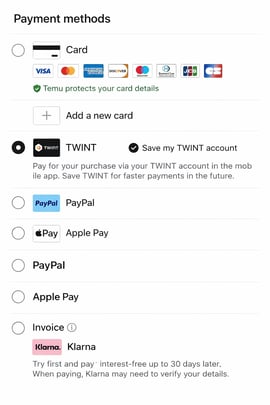 International shops such as Temu and Shein show how this works: TWINT is offered alongside Apple Pay, PayPal, and credit cards and can be saved – a clear conversion advantage in mobile checkout.
TWINT is particularly effective if your mobile target groups and traffic shares are high, for low to medium shopping cart sizes (impulse purchases, repeat purchases), for convenience products such as beauty, accessories, sports, or lifestyle – and generally if you want to quickly “pick up” Swiss customers.
Best practices for TWINT:
- TWINT as a visible option at checkout, not just “hidden” in the dropdown
- Show logo early (shopping cart or checkout start)
- Test checkout on mobile: few steps, no media breaks
- Test TWINT flow consistently (cancellation, timeout, resumption). Important for cross-border retailers: TWINT is currently not available to foreigners – it does not work with German accounts or from Austria (TWINT Austria does not exist). So you offer it specifically to your Swiss customers.
Purchase on account: trust, control, and often a conversion driver
In Switzerland, invoicing is a source of trust for many target groups. It gives customers control and reduces the perceived risk. Especially for higher-priced shopping carts or new shops, invoicing can significantly increase the willingness to buy.
Invoicing is particularly important for higher-priced products (premium, electronics, home & living), for new customers who are not yet familiar with your brand, for target groups that prioritize security and control, as well as for B2B-related buyer groups or repeat orders.
Data from the Swiss Payment Monitor shows: For purchases over CHF 500, credit cards (27.1%) and invoices (25.4%) are equally popular. Around 70% of Swiss retailers offer invoices – and for good reason. Modern forms such as QR-Rechnung Schweiz or eBill Schweiz (e-invoices) with payment terms of 14–30 days are standard in Swiss e-commerce.
What you should pay attention to:
- Clarity regarding payment terms and the reminder process (short and understandable)
- Transparent rules for partial returns and partial refunds
- Fraud and risk management (without unnecessarily frustrating customers)
- Prepare support: invoices, payment status, and the reminder process are top issues
Important: Buy-now-pay-later (BNPL) is growing in parallel with traditional purchase on account. The Swiss BNPL market is estimated to be worth around USD 2.12 billion in 2025, with annual growth of around 12%. Providers such as Swissbilling/Cembra, Klarna, and PayPal are expanding the spectrum. Consider whether installment payment options make sense for your target group.
Credit card: Visa, Mastercard, Amex
Credit cards remain the standard. The Visa card is the most widely used in Switzerland, followed by Mastercard Switzerland. American Express Switzerland (Amex) serves the premium segment. A smooth flow is crucial: if card payments are technically unstable (3D Secure loops, too many steps), you will immediately lose conversions.
Best practices for credit cards:
- As few entries as possible, good mobile usability
- Clear error messages and “Retry” without frustration
- Payment logos visible early on
- Only offer “Save for next time” if you can explain it clearly
The increasing use of neobanks such as Neon, Yuh, or Revolut – often with Visa Debit Switzerland or Debit Mastercard – shows that simplified payment processes are continuing to gain in importance.
PayPal and alternative providers
PayPal Switzerland is well known and is offered in many shops. Nevertheless, PayPal is less dominant at checkout than in other countries. In Switzerland, local solutions such as TWINT and invoicing are the stronger signals of trust.
Apple Pay is experiencing strong growth, while Google Pay and Samsung Pay lag significantly behind.
Global methods such as direct debit or instant transfer are of limited importance in Switzerland. Cryptocurrencies play virtually no role in e-commerce and can be ignored.
The rule of thumb: don't aim to offer “as many” payment methods as possible, but rather the right ones that are well integrated. In many cases, TWINT is the strongest PayPal alternative in Switzerland. Those who offer smooth integration here have a direct conversion advantage.
CHF vs. EUR: Why currency matters
Price psychology in Switzerland
Currency is a psychological factor at checkout. If you display prices in EUR, you force Swiss customers to convert the currency in their heads. This creates uncertainty, slows down decisions, and increases abandonment rates. This effect is particularly strong with higher-priced shopping carts, mixed shopping carts (discounts, shipping, import logic), and mobile checkouts (less patience, faster abandonment).
Prices in CHF, on the other hand, appear “local” and provide security. Many customers evaluate not only the price, but also the risk. CHF reduces this feeling of risk. Around 84% of all online payments are made within Switzerland. This underlines how important clear CHF positioning is for the domestic market.
For EU merchants, the following also applies: import costs (customs duties/VAT) should be transparent at checkout (see cross-border tip below).
Conversion effects with EUR prices
Cross-border euro payments are technically possible via SEPA. But for Swiss customers, CHF is the standard – prices in EUR seem foreign and reduce trust.
EUR prices often cost you potential:
Typical effects include more abandoned shopping carts and checkouts (“How much is that in CHF?”), more questions about fees and exchange rates, less trust in first-time purchases (“Is this really for Switzerland?”), and less willingness to upsell because the price perception is uncertain.
If you want to grow in Switzerland, displaying prices in CHF is a very common quick win.
Cross-border tip: Transparency regarding import costs
When shipping from the EU to Switzerland, it's not just the currency that counts, but also transparency about additional costs. The main reason for negative reviews: surprise customs and VAT charges upon delivery (typically CHF 15–65+ handling fees).
The solution: DDP shipping with all import costs already paid at checkout – delivery like domestic shipping, without additional payments or customs interaction.
Cross-border tip: Transparency regarding import costs
When shipping from the EU to Switzerland, it's not just the currency that counts, but also transparency about additional costs. The main reason for negative reviews: surprise customs and VAT charges upon delivery (typically CHF 15–65+ handling fees).
The solution: DDP shipping with all import costs already paid at checkout – delivery like domestic shipping, without additional payments or customs interaction.
Practical implementation: Structured integration of DDP
Many retailers recognize the advantages of a DDP model, but face operational challenges: Import duties must be calculated correctly, shipments must be declared accurately, and returns must be organized in a customer-friendly manner. To ensure transparency at checkout, a solution is needed that combines technical integration and logistics.
With SmartGate Flex, such a DDP setup can be integrated into existing shop systems. Import duties are automatically taken into account at checkout, shipments are processed as DDP, and returns are organized via a Swiss return address. The model can be seamlessly integrated into common e-commerce systems via API or plugin connections.
For Swiss customers, this creates a shopping experience that feels like a domestic delivery – with a final price that remains transparent at checkout.
Exchange rate and rounding problems
A classic scenario: you display prices in EUR, but later charge in CHF with an exchange rate difference. This feels like a price change to customers.
How to avoid friction:
- Consistent currency throughout the entire journey (from the product page to the order confirmation)
- Stable conversion when working with exchange rates
- Clear rounding logic (no “odd” final prices that look unprofessional)
- Clear statement of the currency in which the charge will be made
Checkout optimization: Reduce abandonment rates
Common reasons for checkout abandonment (and how to reduce them)
Checkout abandonment is usually caused by minor obstacles.
The most common patterns are:
The preferred payment method is often missing (no TWINT, no invoice, no suitable card). The currency is incorrect (EUR instead of CHF, unclear charges, exchange rate uncertainty). There are too many steps (unnecessary fields, too much scrolling, too much typing on mobile devices). There is uncertainty due to a lack of trust signals or unclear information. Or the payment fails without a clear next step being offered.
Studies show that around 8.5% of buyers abandon their purchase if their preferred payment method is not available. For every 1,000 checkout attempts, that's 85 lost customers. Displaying payment methods in the shopping cart significantly reduces uncertainty.
You can most effectively reduce abandonment by making the top payment methods visible, clearly displaying CHF, minimizing checkout steps, and using clear microcopy (“How refunds work,” “Billing in CHF”).
Technical and legal aspects
Payment service providers for Switzerland
For international merchants, a payment service provider (PSP) is often the basis for efficiently connecting multiple payment methods. Large PSPs such as Stripe and Adyen already offer TWINT as a native payment option. In Switzerland, it is crucial that your PSP supports TWINT and invoicing in a meaningful way (depending on the target), accurately reflects CHF billing and settlement, provides good reporting and reconciliation functions, and offers stable checkout performance (mobile, peak times).
Ensure clean internal processes:
- clear billing cycles (settlement)
- transparent fees per payment method
- Refund processes (full, partial, after return)
- Clean accounting and allocation (order ↔ payment ↔ refund)
Especially for invoices and partial returns, it is important that systems map this cleanly, otherwise the workload in support and finance will escalate.
It is important to communicate final prices clearly and not to make contradictory statements between the shopping cart, checkout, and order confirmation. For international setups, it is necessary to clearly indicate whether import costs are included or not. And the refund logic should be explained in an understandable way: when, how, and what amount.
Current trends and forecasts
Swiss e-commerce continues to grow: online sales reached around CHF 18 billion in 2024 (17.3% of total retail sales), an increase of over 20% since 2021. At the same time, payment behavior is changing. Traditional purchase on account remains important, but buy-now-pay-later (BNPL) and digital installment payment options are growing strongly and complementing the established offering. At the same time, regulatory requirements are increasing: since 2023, the new Data Protection Act (DSG) has been in force in Switzerland, which regulates the processing of payment and customer data more strictly. Retailers who adopt DSG-compliant processes early on are creating an additional signal of trust at checkout.
Best practices and common mistakes
Best practices: How to make your payment setup “Swiss-ready”
- Use CHF as the default currency (at least for Swiss users)
- Check TWINT and invoicing and integrate them properly (depending on the target group)
- Prioritize mobile checkout (few steps, fast performance)
- Communicate refunds clearly (briefly, specifically, visibly)
- Test error cases (payment canceled, card declined, returns)
- Measure and iterate (A/B tests: payment method order, CHF display, microcopy)
- Communicate security and data protection (GDPR-compliant since 2023)
Common mistakes (and how to avoid them)
A common error is offering too few payment options. When customers don't see their preferred option, they abandon the transaction. You don't need to offer “everything,” but you do need a suitable set of options for your target group.
Equally problematic: no TWINT or no invoice at checkout – these are often key options for building trust.
Inconsistent currency display (EUR on the product page, CHF at checkout) also looks like a price change – the solution is a consistent CHF journey. Poor payment UX (too many steps, unclear error messages) and unclear refund processes also cost conversions.
Conclusion: Payment and CHF are direct sales drivers in Switzerland
Current market data clearly shows that successful Swiss shops rely on a hybrid payment setup that respects local customs while meeting modern digital expectations. In Switzerland, payment is not only about whether customers can pay, but also whether they feel secure. The biggest levers are often surprisingly simple: familiar payment methods, clear prices in CHF, clear communication, and a checkout process that works smoothly on mobile devices.
If you consistently implement these basics, you will reduce checkout abandonment, strengthen trust, and increase conversion and basket size.