Marketplaces in Switzerland: Your springboard for online sales

Table of contents
What makes Switzerland special as an e-commerce market
Why is cross-border e-commerce worthwhile? The global market for cross-border online trade is growing at a CAGR of 23%—faster than online trade as a whole.
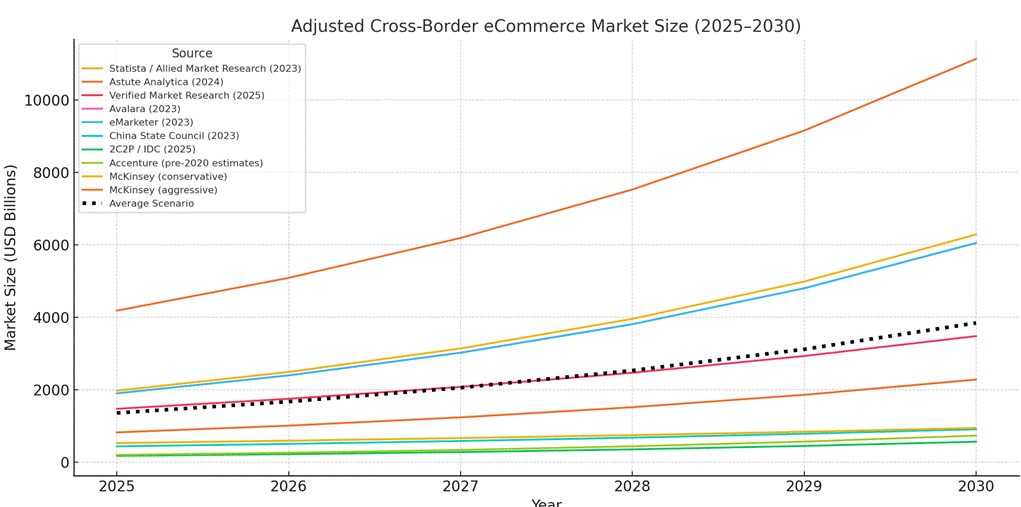
Cross-border e-commerce is one of the fastest-growing segments in global online retail.
But where within this growth market is it particularly worthwhile to get involved? Switzerland is a prime example: small, with strong purchasing power, import-friendly – and with structural advantages that larger markets do not offer.
Market structure: mature, digital, import-friendly
Swiss online retail has stabilized at a high level in recent years. In 2024, the market volume reached CHF 14.9 billion – an increase of 3.5% over the previous year. With online sales accounting for around 17% of retail sales, Switzerland is not a testing ground, but a mature market with established standards and high expectations. The blog article Switzerland – a lucrative cross-border e-commerce gem in the heart of Europe shows why Switzerland is such an attractive market despite its small population.
Particularly relevant for EU retailers who want to sell in Switzerland: cross-border shopping is growing disproportionately. In 2024, Swiss consumers spent CHF 2.6 billion with foreign online retailers – an increase of 18% over the previous year. The main drivers are lower prices and wider product availability. Swiss customers are used to cross-border shopping – but are sensitive to hidden import costs.
The ECDB figures show how strongly Switzerland's major sales platforms dominate this market: Galaxus and Digitec alone had a combined GMV of around €3.55 billion in 2024. Zalando generated further billions in sales through its Swiss store. The large online marketplaces are therefore not only relevant – they are the market.
For you as a retailer, this means that the demand is there. The challenge is not “if” but “how.”
The reality of importing into Switzerland: customs, VAT, and the 5-franc rule
Before you think about marketplaces or D2C, you need to understand the logic behind importing into Switzerland. A detailed breakdown of all regulations can be found in the guide Swiss customs regulations: Those who know them have a head start.
The most important rules for B2C shipments:
5-franc rule (B2C postal shipments): No import VAT is levied on shipments under CHF 5. This corresponds to approximately CHF 62 at 8.1 percent or approximately CHF 192 at 2.6 percent (including shipping). Above this amount, VAT is payable on the total amount.
Abolition of industrial customs duties since 2024: Since January 1, 2024, import duties have been abolished for the majority of e-commerce-related goods. This makes selling to Switzerland more attractive – but VAT and customs clearance fees remain in place.
Customs clearance costs: Postal, courier, and parcel service providers charge fixed or variable fees for customs clearance. These can vary greatly depending on the provider and can be high. In addition, special fees may apply, for example for special goods inspections such as precious metal checks.
Sample calculation: What an $80 order really costs the customer
|
Position |
Amount |
|
product price |
80,00 EUR |
|
shipping |
6,90 EUR |
|
subtotal |
86,90 EUR ≈ 82 CHF |
|
Swiss VAT (8.1%) |
6,64 CHF |
|
Customs clearance fee (post office) |
11,50 CHF |
|
Total cost to customer |
≈ 100 CHF (+22%) |
The reality for Swiss customers when shopping cross-border: customs duties, customs clearance fees, and unexpected additional costs at the doorstep—if you don't solve these hurdles in advance, you lose conversion and trust.

Transparency at checkout can significantly reduce the conversion rate.
Lack of transparency, on the other hand, is detrimental in the long term: although the conversion has taken place, unexpected fees lead to returns, support costs, and a lack of repeat purchases – thereby reducing customer lifetime value and referral rates.
Why marketplaces can solve these problems
Marketplaces such as Galaxus and Zalando have already structurally solved the typical hurdles in Swiss business. As an online retailer, you benefit from an existing infrastructure that is geared towards local expectations.
- Established payment and delivery processes: Swiss customers are familiar with the processes and trust them
- Transparent price display: Final prices include all import costs
- Standardized returns processing: Clear rules and fast refunds
- Better logistics conditions: Thanks to volume and local partnerships
Payment methods are also a decisive factor. ECDB data shows that Galaxus and Zalando offer TWINT, PostFinance, and all major cards in Switzerland. Amazon, on the other hand, does not offer TWINT and PostFinance in its Swiss business—a clear disadvantage in terms of local acceptance.
However, another point is crucial: the sales platforms consistently protect their brand. From the perspective of Swiss customers, they buy from Galaxus or Zalando – even if a partner retailer delivers in the background. Accordingly, the customer journey should function like a local purchase: transparent final price, no additional delivery costs, and a smooth returns process.
That is why these marketplaces usually require their retailers to use DDP logistics. Customs, import VAT, and fees are handled in advance and included in the price. Customers do not encounter any unpleasant surprises at their doorstep – even if the goods come from another EU country and take one to three days longer to arrive.
However, it must now be made clear here, and this can be highlighted in a highlight box if necessary, that these very platforms, Galaxos and Zalando, require retailers who sell through them to use appropriate DDP logistics so that there are no nasty surprises for customers at their doorstep.
Why is that? At the end of the day, Swiss customers buy from Galaxos or Zalando, even if there is a partner retailer behind them. The reputation of Galaxos and Zalando is extremely important to both of them, so naturally they want Swiss customers to have a normal local customer journey, with the only difference being that it takes one, two, or, depending on where in Europe the goods come from, three days longer than if the goods were shipped locally in Switzerland.
No sales on leading Swiss marketplaces without DDP
Anyone selling through Galaxus or Zalando must calculate and settle import costs in full in advance. This is the only way to ensure that the customer journey remains local, transparent, and brand-compliant.
No sales on leading Swiss marketplaces without DDP
Anyone selling through Galaxus or Zalando must calculate and settle import costs in full in advance. This is the only way to ensure that the customer journey remains local, transparent, and brand-compliant.
An overview of the three entry strategies
Strategy 1: Marketplace-first (springboard)
You use marketplaces in Switzerland to quickly build up sales and experience – without your own local infrastructure.
Suitable if you:
- Are in categories with strong marketplaces (electronics, home & living, fashion)
- Want to test demand in the short term without high upfront investments
- Don't have brand awareness in Switzerland yet
Advantage: Fast market access, low risk, immediate access to millions of customers
Disadvantage: Limited margin control, no first-party data, dependence on platform rules
Strategy 2: D2C-first (brand and margin focus)
You enter Switzerland directly with your own shop and build customer relationships without intermediaries.
Suitable if you:
- Have a strong, differentiated brand
- Prioritize repeat purchases and CRM relationships
- Are willing to invest in localization, payment, and trust elements
Advantage: Full control over margins, customer data, and brand experience
Disadvantage: Greater effort required to build trust, logistics, and customer service
Strategy 3: Hybrid (often the best strategy for Switzerland)
You combine both: the online marketplace as a reach and test engine, D2C as a brand and profitability engine. Marketplaces deliver reach, traffic, and quick insights without marketing investment. D2C delivers higher margins, customer data for CRM, and full control over brand experience and pricing. The synergy: marketplace for new customer acquisition, D2C for repeat purchases with higher customer lifetime value.
How hybrid works in practice:
Phase 1 (months 1-6): Start on a marketplace to validate demand and bestsellers
Phase 2 (months 4-9): Use the learnings (price sensitivity, return rates, category performance) to build your D2C presence
Phase 3 (from month 9): Parallel operation – marketplace for new customer acquisition, D2C for repeat purchases and higher margins
Galaxus – Switzerland's most important marketplace
When it comes to marketplaces in Switzerland, there is no way around Galaxus. With platform sales of CHF 3.228 billion (2024) and 18% growth, Galaxus is Switzerland's largest online marketplace. Together with Digitec, the company attracts over 27 million visits per month.
Target group and reach
Galaxus has a broad range of products: consumer electronics, home & living, sports, beauty, DIY, toys, and more. According to ECDB, hobby & leisure leads with 23.9%, followed by electronics (19.6%), fashion (17%), and DIY (16%). Digitec is highly concentrated: 91.1% of its sales are in consumer electronics. Anyone selling electronics should consider both platforms – including as a Digitec partner.
In 2024, Galaxus had around 5.97 million active buyers and 11.9 million orders with an average order value of around 180 euros. The platform deliberately positions itself as a curated marketplace: retailers are hand-picked and must fit the brand.
The third-party provider share is growing particularly dynamically: the 3P GMV at Galaxus rose from €310 million to €530 million – an increase of 71%. The opening of the marketplace to external online retailers is gaining massive momentum. The ECDB forecasts further growth in the 3P share to €770 million by 2025.
Galaxus is also expanding beyond Switzerland: in 2024, the company operated seven stores in Switzerland, Germany, Austria, France, Italy, the Netherlands, and Belgium. The German store grew particularly dynamically, with an increase of 38.5%. This results in an additional advantage for EU retailers: once listed, they can potentially serve multiple markets via the same platform.
Becoming a Galaxus retailer: requirements at a glance
Galaxus is strongly data- and process-driven. Anyone who wants to become a Galaxus retailer must meet the following requirements:
Basic requirements: Registered company with a valid VAT ID number, own warehouse in the EU/CH, technical connectivity (ERP or shop system).
Product data: The Galaxus retailer program requires CSV format (UTF-8, semicolon), mandatory fields EAN, product name, stock, price, image links. Complete attribute maintenance and daily updates via FTP or API. Images at least 1000 × 1000 px, white background. The blog article Data quality in e-commerce shows how crucial good product data is for cross-border success.
Logistics: Predictable delivery times, tracking information, performance influences visibility. In Switzerland, according to ECDB, Galaxus works with Swiss Post and Planzer, supplemented by Click & Collect.
The EU hub and technical connection
For EU retailers who want to sell on the Swiss marketplace, Galaxus offers the EU hub – a fully integrated customs clearance solution. This allows you to sell in Switzerland without having to handle customs processes yourself. The technical connection is made via shop systems (Magento 2, Shopify) or middleware (ChannelEngine, Channable, Tradebyte, Xentral) – either as partial automation via FTP or full automation via API.
Commissions range from 8% to 15% depending on the category, and there are no basic fees.
Galaxus conclusion: Start with a manageable test range, invest in data quality early on, and use the EU Hub for smooth customs clearance.
Amazon.de and Switzerland: a special case with potential
Amazon is a special case in Switzerland. There is no Amazon.ch, but many Swiss people order via Amazon.de. According to ECDB, Amazon's Swiss GMV in 2024 was around €1.58 billion – just 0.2% of Amazon's global GMV. For online retailers, this means less platform investment in local features, but also less competitive pressure.
The low order value is striking: Amazon's global AOV is €43, compared to €180 at Galaxus. With such small shopping baskets, import costs eat into the margin more quickly.
DDP, shopping basket, and channel suitability
The same applies to Amazon.de: anyone selling to Switzerland needs DDP logistics. The key difference to Galaxus and Zalando is that at Amazon.de, the responsibility for calculation and processing lies more with the retailer. Import costs, VAT, and fees must be integrated into the sales price independently – and with Amazon's typically low shopping carts, these costs have a greater percentage impact.
Amazon.de is therefore primarily suitable for Switzerland as a selective additional channel – not as a comprehensive market entry strategy. The ECDB category data shows which segments Amazon dominates: electronics (37.6 percent) and hobby & leisure (30.9 percent), while fashion accounts for only 8.8 percent. Demand also exists in Switzerland in precisely these core categories – albeit with significantly lower shopping carts than at Galaxus.
Successful Amazon.de → Switzerland sellers typically focus on:
- Products with sufficient contribution margin
- Goods values from around EUR 80–100
- Low return rates
- Clearly differentiated niche items
Amazon is therefore not an all-round channel for Switzerland, but rather a tactical tool for niche items with stable pricing – such as technical accessories, specialist literature, or licensed brand products that are not listed on Swiss sales platforms, or only to a limited extent.
Zalando: The fashion giant with clear rules
Zalando is the dominant channel for fashion and lifestyle in Switzerland. According to the Carpathia ranking, Zalando is the B2C online shop with the highest turnover in Switzerland. The ECDB estimates the GMV of zalando.ch at €1.15 billion, making Switzerland Zalando's fourth-largest market (after Germany, the Netherlands, and France) and accounting for 8.9% of total GMV.
The category focus is extreme: 87.1% is accounted for by fashion (apparel 55.7%, footwear 17.5%, bags & accessories 14%). With around 51.8 million active buyers and a purchase frequency of 4.5 orders per year, Zalando has the highest repurchase rate. The AOV is €56 – lower than at Galaxus, which is typical for fashion. The return rate at Zalando is significantly higher than at Galaxus – a cost factor that we will examine in more detail under the most common mistakes.
Requirements for Zalando partners
Zalando is curated and performance-oriented. The platform rules define:
- EAN-13 mandatory, EU-compliant labeling
- Grade A quality, delivery from EU warehouse (shipping from outside the EU prohibited)
- Zalando-approved carrier
- Prepaid return label
In Switzerland, Zalando uses Swiss Post as its shipping service provider. Zalando carries out regular test orders. Violations are classified as blockers (deactivation) or downsorters (less visibility).
Logistics solutions and connection
Zalando offers several logistics options: Own fulfillment (own EU warehouse), Zalando Fulfillment Solutions ZFS (end-to-end by Zalando), Zalando Shipping Solutions ZSS (cross-border solution), and ZEOS as a multi-channel setup. Tradebyte is listed as a preferred integrator. The Partner University documents the entire onboarding process.
For retailers with growth ambitions, however, it is not only the logistics solution that is crucial, but also the integration strategy. Tradebyte is not used exclusively for Zalando, but can also be connected to Galaxus. Anyone who wants to operate on several marketplaces in Switzerland at the same time should therefore check early on whether a central middleware solution standardizes processes and facilitates scaling.
Think strategically about integration—not platform-specific.
If you want to serve multiple Swiss marketplaces, you should rely on central middleware. This reduces complexity, simplifies feed management, and creates the basis for efficient scaling.
Think strategically about integration—not platform-specific.
If you want to serve multiple Swiss marketplaces, you should rely on central middleware. This reduces complexity, simplifies feed management, and creates the basis for efficient scaling.
D2C as an alternative: When is it worthwhile to have your own Swiss shop?
Having your own shop requires more effort, but it is a strategic asset. Anyone who wants to sell in Switzerland has to resolve several issues themselves when taking a D2C approach:
|
Topic |
Requirements for Switzerland |
|
payment methods |
TWINT, PostFinance, purchase on account – Swiss customers expect local options |
|
price display |
CHF with Swiss price anchors (49.90, 99.–) |
|
import expenses |
Transparent checkout or DDP model |
|
delivery options |
Predictable delivery times (2-4 business days from Germany) |
|
returns |
Swiss return address or clear return process |
|
trust elements |
Seal of approval, local customer service number, CH domain |
Implementing local payment methods is less technically complex than expected: payment service providers such as Datatrans, Worldline, and Adyen support TWINT and PostFinance for all common shop systems.
What Swiss customers specifically expect: transparent prices including all fees, fast delivery (2-3 days), uncomplicated returns, and local payment methods such as TWINT.
ECDB payment data confirms that Galaxus and Zalando already cover this spectrum – anyone who wants to be competitive in the D2C sector must at least come close to matching this.
The 5 most common mistakes when expanding into Switzerland
Mistake 1: Treating import costs as a customer problem. If the customer has to pay an additional CHF 20-25 upon delivery, this will result in negative reviews and abandoned purchases. The Foundation for Consumer Protection warns that foreign online shops often incur additional customs costs that are not included in the purchase price. Solution: Offer DDP shipping or communicate the total costs transparently at checkout – the Amazon section above shows why DDP is crucial. The EU hub of Galaxus or Zalando Fulfillment Solutions solve this automatically. The guide shows how you can save up to 60% on shipping costs with the right 6 savings options.
Mistake 2: Simply converting euro prices. EUR 49.90 ≠ CHF 47.23. Swiss price anchors are different. An “odd” price looks unprofessional and signals that the shop is not geared towards Switzerland. Solution: Conscious CHF pricing strategy with psychologically effective endings such as 49.90, 99.– or 149.–. Swiss people often use “–” instead of “,00.”
Mistake 3: Treating product data as an afterthought. At Galaxus and Zalando, data quality determines visibility. Incomplete data = poor filterability = less visibility = fewer sales. Solution: Set up the data structure according to the platform documentation before launch. Integrators such as Channable or Tradebyte help with feed optimization.
Mistake 4: No channel strategy. When marketplaces and D2C show the same products at different prices, cannibalization and price confusion arise. Solution: Clear distribution of roles – e.g., Swiss marketplace for standard range, D2C for bundles, exclusive products, and personalized offers.
Mistake 5: Underestimating returns. Fashion return rates of 40-60% are normal in Switzerland. According to ECDB, returns account for 13.5% of the gross order value at Zalando – almost twice as much as at Galaxus (7%). At Digitec, the figure is 7.7%. Solution: Factor in return costs from the outset. Guarantee fast refunds (target: <5 business days). At Zalando: Use ZFS for optimized processing.
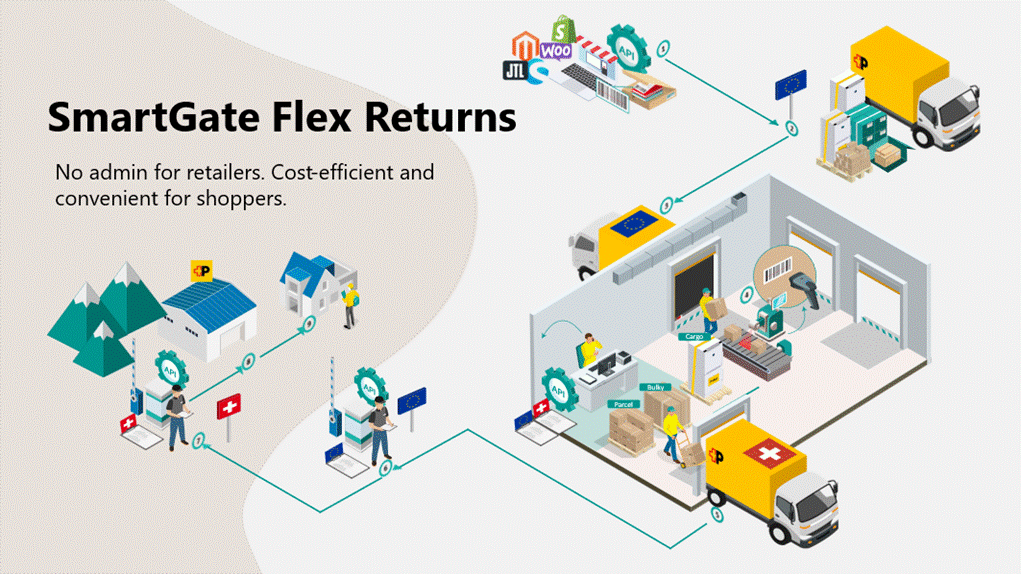
This is how a professional cross-border returns process works: With solutions such as SmartGate Flex Returns from Swiss Post, returns from Switzerland are processed without any administrative effort for retailers – cost-efficient and convenient for customers.
Mistake 6: Underestimating delivery performance.
Slow or unreliable delivery times have a direct impact on visibility. Marketplace algorithms take delivery performance, cancellation rates, and punctuality into account. Those who repeatedly deliver late or offer poor tracking quality will be deprioritized in the ranking – with immediate effects on traffic and sales.
Solution: Specify realistic delivery times, provide accurate tracking information, and aim for a punctuality rate of over 95 percent. Logistics is not just a cost factor, but also a ranking lever.
Decision matrix: Which channel is right for you?
|
Category |
Recommended channel |
Justification |
|
Consumer Electronics |
Galaxus (Digitec) |
Strong demand, high comparability, AOV ~180 EUR |
|
Home & Living |
Galaxus |
Wide range, good margins possible |
|
Fashion & Lifestyle |
Zalando |
Dominant channel (CHF 1.7 billion), high purchase frequency |
|
Sport & Outdoor |
Galaxus + D2C |
Galaxus for reach, D2C for community |
|
Beauty & Kosmetik |
Zalando / D2C |
Zalando for mainstream, D2C for niche |
|
Premium/Niche |
D2C-first |
Brand protection, brand control |
|
Test range |
Amazon.de |
Quick start, but note import logic |
Questions to consider when making your decision:
- How well known is your brand in Switzerland?
- What is your typical return rate in this category?
- Can you calculate CHF prices with a healthy margin (after commission, logistics, returns)?
- Do you have the capacity for the data quality that Galaxus/Zalando require?
- How important are first-party data and CRM capabilities to you?
Is your logistics setup adequate?
You now know which channel suits your product range—but is your logistics setup right? The Cross Border E-Commerce Optimizer gives you an initial assessment in just a few minutes.
Is your logistics setup adequate?
You now know which channel suits your product range—but is your logistics setup right? The Cross Border E-Commerce Optimizer gives you an initial assessment in just a few minutes.
The 7-step plan for expanding your marketplace into Switzerland
Step 1: Market and channel evaluation (weeks 1–2)
Check: Which categories are performing well in Switzerland? Who dominates the shelves? Is the setup profitable in terms of commission, logistics, VAT, and returns? Result: Category shortlist with potential assessment and margin calculation
Step 2: Select marketplace (weeks 2–3)
Use the decision matrix above as a guide: Wide range, non-fashion → Galaxus. Fashion & lifestyle → Zalando. Quick test with existing DE setup → Amazon.de. Premium/niche → D2C-first. Result: Decision on primary channel, secondary channel if necessary
Step 3: Product range and pricing strategy (weeks 3-4)
Start with 20-50 test SKUs. Calculate prices in CHF including all costs. Plan for return risk per category (fashion: 40-60%, electronics: 5-15%). Result: Product range list with prices in CHF and margin calculation
Example margin calculation:
|
Position |
CHF |
|
Target retail price Switzerland |
99.90 |
|
./. Commission (12%) |
-11.99 |
|
./. Logistics DE→CH |
-7.50 |
|
./. Return risk (20%, $15/return) |
-3.00 |
|
./. VAT portion (if DDP) |
-7.48 |
|
= Net proceeds |
69.93 |
|
./. Purchase price |
-45.00 |
|
= Gross profit |
24.93 (25%) |
Step 4: Logistics setup (weeks 4-5)
Option A: Cross-border from EU warehouse Quick start-up, no Swiss warehouse required. Delivery time 3-5 business days. DDP shipping recommended (customs clearance by you or service provider). Suitable for test phase and moderate volumes.
Option B: Swiss fulfillment or platform solution Better delivery times (1-2 days), no customs clearance issues for customers, but higher fixed costs. Suitable for established businesses, high volumes, and fashion with high return rates.
The guide – Logistics for shipping to Switzerland shows you how to optimize your setup.
Step 5: Content and data (weeks 5-6)
Product data checklist:
- EAN/GTIN for each product
- Product images at least 1000 × 1000 px, white background
- Complete attributes according to platform taxonomy
- Prices in CHF with correct VAT display
- Inventory management with daily (better: hourly) updates
Recommended resources and onboarding links:
|
Platform |
Onboarding & Requirements |
Product data & feeds |
|
Galaxus (inkl. Digitec) |
Dealer program & technical connection Galaxus dealer program overview (EN) |
API/FTP connection, middleware such as Channable or Tradebyte (Galaxus) |
|
Zalando |
Partner Program & Onboarding (via zDirect) Zalando Partner Onboarding Information |
Structured attributes, image quality, compliance data (partner.zalando.com) |
|
Amazon |
Seller Central Sell on Amazon US | Build your e-commerce business
|
EAN/GTIN, Bilder, VAT-Attribute |
Result: Product feed in platform format, technical connection tested
Step 6: Test phase and KPI tracking (weeks 7-12)
Track these KPIs:
|
KPI |
Target value |
Why it is important |
|
Conversion Rate |
>2% |
Price/product fit (platform benchmark: Galaxus 3.5%, Zalando 2.9%) |
|
Cancellation rate |
<5% |
Visibility at Galaxus |
|
Delivery performance |
>95% on time |
Customer satisfaction, platform ranking |
|
Return rate |
Category benchmark |
Cost-relevant, indicator of product quality |
|
Rating |
>4,0 ★ |
Trust signal, influences conversion |
Result: Weekly KPI dashboard, documented findings
Step 7: Scaling (from month 4)
If the fit is right:
- Gradually expand the product range (based on performance data)
- Automate processes (full integration, API connection)
- Build or optimize D2C in parallel
- Test paid marketing on the marketplace (sponsored products, etc.)
- Evaluate a second marketplace (e.g., Galaxus + Zalando for different categories)
The ECDB forecasts for 2025 are optimistic: Galaxus is forecast to reach €2.49 billion GMV (+16.3%), Digitec €1.56 billion (+9.5%). The 3P share is growing disproportionately – a good sign for third-party providers.
Result: Scaling plan with milestones and budget
Conclusion: Marketplaces as a springboard, not a final destination
For most EU retailers, marketplaces in Switzerland are the fastest and lowest-risk way to enter the Swiss market.
Key findings:
- Switzerland is not a test market – CHF 14.9 billion in volume, high expectations, established standards
- Import costs determine conversion – Understanding and solving the 5-franc rule and customs clearance fees
- Data quality is your ticket in – Galaxus and Zalando reward process discipline with visibility
- Hybrid is often the best strategy – marketplace for acquisition, D2C for margin and customer loyalty
- Start focused, scale based on data – test 20-50 SKUs, then expand based on what you learn
Important from 2025 – Platform taxation: From 2025, new rules will apply in Switzerland: Platforms with over CHF 100 million in sales from third-party providers will themselves be subject to VAT. For you as a retailer, this means: Check whether your marketplace will pay VAT directly in the future. This is likely to be the case with Galaxus and Zalando – your net price calculation could change as a result. Find all the details in the blog article Platform taxation from 2025.
Your next step: Start with a focused test range on the marketplace that suits your category. Invest in data quality and logistics early on. And plan from the outset how you will use what you learn for your hybrid expansion.