The Swiss e-commerce market: An overview for international online retailers
Table of contents
Market overview Switzerland
Why Switzerland is interesting for you
Switzerland is smaller than Germany, but has strong purchasing power and is very active in online retail. The Swiss market attracts with its high purchasing power and digitally savvy consumers. Many Swiss customers regularly order from abroad. They do not do this by chance, but because they see clear advantages. These usually include better availability, a wider selection, or a more attractive overall package of price, service, and delivery.
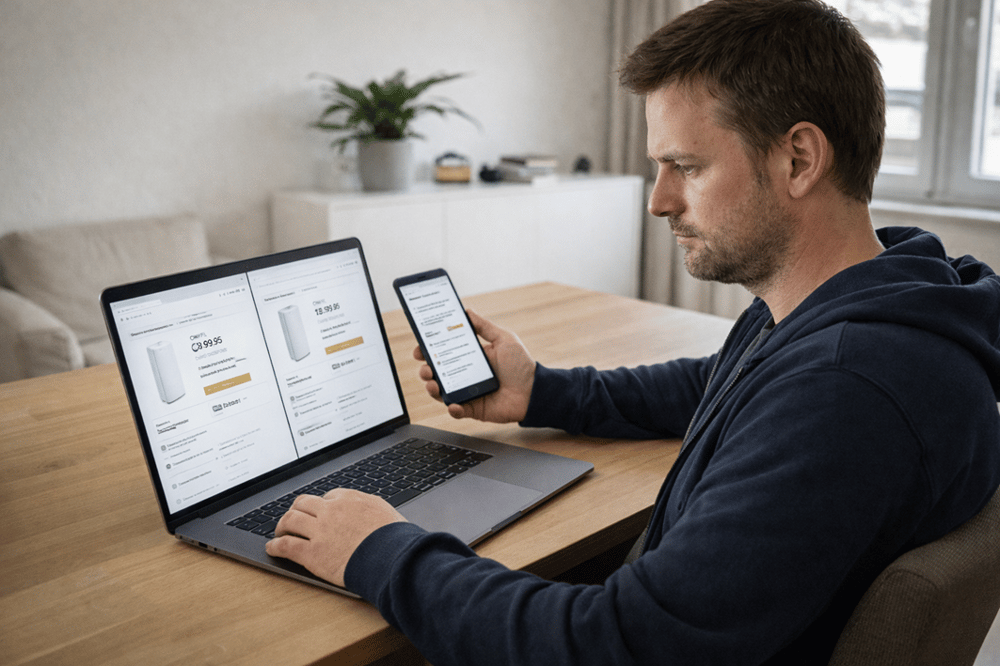
It is important to note that Swiss consumers do not buy internationally blindly. Due to customs barriers and often negative experiences with imports to Switzerland, they pay close attention to the service offered by the shop—especially with regard to customs clearance and return conditions. If you meet these expectations, you will quickly gain trust. And trust is a direct lever for repeat purchases and recommendations in Switzerland.
What makes the Swiss market special
Many international retailers think first and foremost about marketing: performance, influencers, SEO, campaigns. That's important. In Switzerland, however, something else often determines your success: your operational setup and transparency.
You can have the best traffic. But if your cost logic is unclear or customers suddenly have to pay upon delivery, conversion will plummet. And your brand will suffer. That's why it's worth taking a look at the specifics that make the difference:
-
Customs border as part of everyday life
The customs border is not a “special case.” It is the rule. All shipments of goods must pass through Swiss customs and be cleared! This affects data, processes, costs, delivery times, and communication. Those who accurately translate Swiss customs import regulations into processes and texts come across as professional.
-
CHF instead of EUR
Currency is psychology—not just exchange rates. Swiss customers want to know what they are paying. Any uncertainty at checkout costs you conversion. -
Multilingualism
German is often the largest part of the market, but not the entire market. Anyone who wants to grow in western Switzerland or Ticino must also consider French and Italian. This does not have to be “everything” right away, but content that is critical to purchasing must work. -
High expectations for reliability
Predictability is a sign of quality. This applies to delivery times, tracking, returns, and support. Swiss customers are used to processes running smoothly. If you deliver reliably and communicate proactively, you can also convince them with a premium price. -
Transparency is a sign of trust
In Switzerland, transparency is not “nice to have.” It is part of the product. Transparency means clear delivery terms, clear cost logic, and clear statements on returns and refunds.
Which product categories are particularly exciting
Regardless of which industry you are in, there are clear patterns in Swiss cross-border e-commerce. The decisive factor is not so much the category itself, but whether your offer is convincing in three areas: availability and selection, clear final prices, and reliable delivery.
Fashion & Lifestyle
Details are crucial here. Size charts, material information, fit advice, and a simple national returns process are key. Many retailers in Switzerland lose business not because of the product, but because returns are too slow or too complicated.
Professional tip
Find out how to set up efficient returns processes and avoid typical pitfalls in our article Returns in e-commerce—optimize your processes.
Professional tip
Find out how to set up efficient returns processes and avoid typical pitfalls in our article Returns in e-commerce—optimize your processes.
Beauty & Personal Care
Trust and data quality are important in this category. Ingredients, application, and declarations reduce queries. In addition, the issue of VOCs comes into play. VOC stands for “volatile organic compounds,” which are found in many cosmetics and personal care products. Switzerland levies an incentive tax of CHF 3.00 per kilogram of VOC content. Important: The tax is calculated based on the pure VOC content, not the gross weight of the shipment – provided you submit the exact data to customs. You can find out how to integrate the VOC tax into your setup in our article on the VOC tax in Switzerland.
From practice: Atout Cosmetics
Luxury cosmetics distributor Atout Cosmetics sells high-quality niche brands in the DACH region. With the right setup, it is possible to offer Swiss customers a shopping experience that builds trust:
“For our customers, shopping is just like ordering from a Swiss store.”
— Henri Bechtolf, Head of Business Development, Atout Cosmetics GmbH
From practice: Atout Cosmetics
Luxury cosmetics distributor Atout Cosmetics sells high-quality niche brands in the DACH region. With the right setup, it is possible to offer Swiss customers a shopping experience that builds trust:
“For our customers, shopping is just like ordering from a Swiss store.”
— Henri Bechtolf, Head of Business Development, Atout Cosmetics GmbH
Consumer electronics & accessories
Specifications must be correct. Warranty and after-sales processes must be clear. For products with batteries or rechargeable batteries, you need clean processes to avoid delays. For products with built-in rechargeable batteries, you need to be aware of the issue of dangerous goods. Your packages may require the LQ special service (Limited Quantities), which allows the transport of limited quantities of dangerous goods such as lithium-ion batteries in the parcel channel.
Home & Living
Dimensions, material, care instructions, and delivery conditions are important. Transparency is particularly crucial for bulky products. There tend to be many products that cannot be transported via parcel delivery and require freight delivery for the last mile. If you have a need for general cargo, we would be happy to help you.
Sports & Outdoor
Seasonal peaks and “buying for a date” are typical. The more predictable your delivery is, the stronger your conversion will be. The same challenges apply here with regard to general merchandise as with Home & Living.
Premium and specialty ranges
Switzerland can be particularly attractive here because customers are specifically looking for something that is “not available everywhere.” In this segment, the winners are often those who offer availability, service, and a clear, high-quality experience. Transparency and reliability count for more here than aggressive discount campaigns.
DE, AT, CH: What is similar and what is not
If you are from Germany or Austria, you have advantages: cultural proximity, similar shopping habits, and language overlaps. Importing from Germany to Switzerland is a particularly common route. Nevertheless, there are differences that you should plan for early on. Customs and import processes change the customer journey and your cost logic. CHF changes price perception and checkout abandonment rates. Payment preferences are different – TWINT and purchase on account play a central role. Multilingualism requires clear prioritization, and trust is built more through transparency than through “EU branding.”
If you plan for these points early on, you will save yourself expensive modifications later on – and you will be able to scale more quickly and stably. You can find an in-depth analysis of market structure, purchasing behavior, and key differences between the EU and Switzerland here.
Legal framework
Swiss value added tax (VAT): What you as a merchant really need to understand
For your everyday life, it is less important to know every rule of Swiss VAT law by heart. The key thing is that you understand the logic behind Swiss VAT and reflect it correctly in your setup. Essentially, there are three questions to consider:
- Who pays the import duties?
This depends directly on your shipping model (DDP or DAP). If customers have to pay (DAP), you must communicate this very clearly. If you pay (DDP), you must ensure that you have the process under control—and communicate this just as clearly. We show you how to market your logistics advantages in a targeted manner in our article on logistics as a marketing tool. -
Will you be liable for tax in Switzerland?
Switzerland levies VAT on turnover exceeding CHF 100,000 – on global turnover, not just the Swiss portion. If you exceed this threshold, you must register and appoint a fiscal representative in Switzerland. The current Swiss VAT rate since 2024: standard rate 8.1%, reduced rate 2.6%, special rate for accommodation 3.8%. When importing into Switzerland, Swiss import sales tax is also payable, which is based on the respective Swiss VAT rate. You can find out what fiscal representation means for you in our article on fiscal representation in Switzerland. New from 2025: Platform taxation – Marketplaces such as Amazon, Zalando, or Galaxus must pay VAT themselves for sales made via their platforms. This can relieve you as a retailer, but you remain subsidiarily liable. -
How do you communicate prices and taxes correctly?
In Switzerland, it is crucial that customers understand whether the checkout price is the final price. Unclear statements lead to cancellations or frustration upon delivery.
Practical tip: If customers are unsure whether there will be additional costs, conversion rates will drop.
Swiss customs clearance and import duties: From “complicated” to “standardized”
Swiss customs appear complicated because many retailers leave customs clearance until the last minute. In practice, it is a system based on data and routine. To correctly map Swiss customs duties and ensure smooth customs clearance in Switzerland, you need a solid foundation: clean product data with descriptions, materials, purposes, and specifications; correct values including item prices, discounts, and shipping cost logic; clean tariff classification with the correct Swiss customs tariff numbers; and clear documents such as invoices and, if necessary, supporting evidence. In addition, restrictions must be observed – for example, for dangerous goods, batteries, or certain ingredients.
Good to know: Switzerland abolished industrial tariffs on January 1, 2024. As a result, many products are no longer subject to customs duties according to the Swiss customs tariff – but VAT and any incentive taxes (e.g., VOC) remain in place. However, there is no general Swiss customs exemption limit for import sales tax: VAT is generally levied from the first franc, provided that the tax amount exceeds CHF 5. How these relationships can be translated into clean customs processes is described in detail here.
Registration requirements and governance: Get it right early on
Registration requirements depend heavily on how you deliver and how your business model is structured. The Swiss Customs Administration (BAZG) defines the regulatory requirements. That's why clear governance is worthwhile:
-
Who is responsible for taxes and customs at your company?
-
Who maintains product data and who checks quality?
-
How often do you check product ranges for restrictions?
-
Which partners or tools support you in the process?
-
How do you ensure that marketing and operations communicate the same cost logic?
A simple “definition of done” is particularly helpful for Switzerland: product data complete, delivery terms specified, cost communication checked, returns process defined, support templates ready.
Returns and warranty: actively managing expectations
Many Swiss customers expect customer-friendly returns because they are familiar with similar offers from EU shops. For you, this means: clearly stating what is possible, making it easy, explaining the process, and keeping the conditions understandable. Communicating transparently here builds trust—and reduces support inquiries at the same time.
A strong standard approach includes a national return address in Switzerland, a clearly communicated return period, simple labels and steps, and transparent information about refunds – i.e., when, how, and where the money goes. In addition, you should define understandable rules regarding condition and exceptions and ensure that your support team is easily accessible for inquiries.
If you handle returns well, you will not only reduce complaints, but also increase the willingness to buy. The legal framework that plays a role in this is summarized in a practical way here.
Logistics and shipping to Switzerland
Shipping models: DDP vs. DAP (determines conversion)
In cross-border e-commerce to Switzerland, delivery terms are often the most important growth lever. They determine whether your offer appears “simple” or “risky.” With DDP (Delivered Duty Paid), you cover import duties, customs clearance, and the cost logic—customers pay nothing more upon delivery. With DAP (Delivered At Place), customers pay import duties and fees upon delivery.
DDP often works better because customers see the final price at checkout and there are fewer surprises. Support costs decrease, repeat purchases increase, and reviews are better because the entire experience feels more local.
Sample calculation (shopping cart CHF 150):
DDP: Customer pays $150 at checkout – done
DAP: Customer pays $150 + approx. $12 VAT + approx. $10–15 customs clearance fee upon delivery = approx. $175–177. The costs for customs clearance in Switzerland vary depending on the service provider and type of shipment.
DAP can work if you are very transparent. A vague note such as “fees may apply” is not enough. Swiss customers want to know what this means in concrete terms.
If you offer DAP, include a clear note explaining the process in two to three sentences – with an estimate or sample calculation.
Customs clearance in practice: How to make customs clearance between Germany and Switzerland manageable
Clearing goods through customs in Switzerland is no magic trick. It involves data processing and procedures – and it's best to proceed step by step. Start with a core range: take your top sellers, around 100 to 500 SKUs, not 20,000 straight away. This will stabilize quality before you expand your range. Then build a “Swiss-ready” data profile. For each product, you need a clear description, a realistic weight, consistent values, and information about restrictions. Many steps in the online customs clearance process in Switzerland can now be handled digitally and automatically.
Before you scale up, you should test the entire end-to-end process – with real shipments and an eye on how the process feels for the customer. At the same time, it is worth standardizing exceptions early on: What happens in the event of partial returns, refusal of acceptance, or address errors? And finally, build clear interfaces between the shop and processing. Many problems arise precisely at these transfer points – due to incorrect weight, missing descriptions, or unclear discount logic.
Delivery times: Swiss customers want predictability
Swiss customers expect clear delivery times, reliable tracking, and proactive communication. Typical delivery times from Germany to Switzerland are 2–5 business days—provided that Swiss Post and customs processing runs smoothly.
Three specific tips:
- Provide realistic delivery times, not the best ones. It's better to say 3–5 days and stick to it than 1–2 days and constantly break your promise.
- Show active status. Tracking is a sign of trust.
- Explain the process at the Swiss border and customs without overwhelming the customer. A short note (“We take care of the import processing”) removes uncertainty.
Return logistics: The return journey is part of your product
Many retailers plan the outward journey perfectly and treat returns as a secondary process. In a cross-border setup, this is expensive. A good returns setup starts with the customer experience: simple steps for labels, drop-off, and returns, a national returns address in Switzerland—so that shoppers have the usual uncomplicated returns experience—and clear expectations regarding duration and refunds.
Behind the scenes, you also need clear structures. Returns must fit into the data logic of the original order, and you should decide early on where the goods will ultimately go – back to the EU hub or for processing. Define transparent rules on deadlines, condition, and exceptions. Particularly important: link the return data to the original EU export. This will help you avoid paying customs duties again when re-importing into the EU – provided that the Swiss customs export is also correctly documented.
Additional practical tip: Determine how you will handle partial returns and how you will automate communication. The fewer manual decisions you have to make, the more stable your process will be.
Payment methods and currencies
Payments: Local beats global
Many international shops in Switzerland rely on credit cards and PayPal. This works, but is often not enough. Swiss customers have clear preferences—and these differ significantly from other European markets.
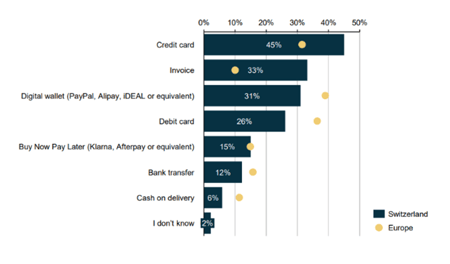
Source: IPC Cross-Border E-Commerce Shopper Survey 2025
The data shows that credit cards are widely used, but invoices and digital wallets play an above-average role. Invoices in particular act as a trust anchor because they provide control and reduce the perceived risk.
What matters in practice:
-
For many target groups, invoices are a source of trust
-
Credit cards are standard, but not always the first choice
TWINT in particular has established itself as a local alternative – fast, mobile, and firmly anchored in everyday life in Switzerland. By mid-2025, TWINT had over 6 million users out of a total population of around 9 million.

A good approach: Start with invoice, card, and TWINT – provided this suits your target group. Optimize the checkout flow and error messages, and measure the conversion rate for each payment method to identify reasons for abandonment. Only expand your payment options if you have a clear reason to do so, such as a B2B focus, installment payments, or specific target groups. And don't forget: CHF vs. EUR – currency is conversion.
If you only show prices in EUR, your shop will quickly come across as “not for me.” Swiss customers convert the prices in their heads, which creates uncertainty. Better: Show prices in CHF as standard for Swiss users, keep the exchange rate logic stable, and avoid jumps between the shopping cart and checkout. Communicate clearly whether all costs are already included.
A single sentence can make a big difference here. For example: “All costs, including import duties and fees, are included in the checkout.” Or, if you deliver DAP: “Import duties will be charged upon delivery. We will show you an estimate at checkout.” The important thing is to say something specific. Not just “could.” The payment methods that are specifically expected in the Swiss market are clearly presented here.
Customer requirements and UX
Language: How to prioritize DE, FR, IT sensibly
Switzerland is multilingual. You don't have to translate everything perfectly from day one. But you do need a plan. In the first phase, you should perfect your German texts – specifically where it counts: product pages, shopping cart and checkout, shipping and returns pages, FAQs on costs, delivery, and refunds, as well as order confirmations and tracking emails.
In the second phase, French is worthwhile for growth in western Switzerland. First, translate the pages that are critical for purchasing – support templates are also invaluable here. Then comes Italian for Ticino, also with a focus on the most important pages first. It is often enough to start with a clean core and expand step by step.
Consistency and clarity are important. Simple language is preferable to complicated translations that sound unnatural.
UX: Clarity beats empty phrases
Some EU shops use aggressive discount strategies and countdown timers. In Switzerland, such elements can also be effective, but they do not replace what really counts:
-
clear final price

- clear delivery time
-
clear import procedure
-
clear return and refund police
- reputable contact options
Three UX elements that are often underestimated:
- Cost box at checkout
Be clear: List the item, shipping, and, depending on the model, import costs. If DDP: mark “inclusive.” If DAP: explain the logic clearly. If you can get customers to understand the final price without having to think about it, you have a big advantage.
-
FAQ near the purchase button
Don't hide it. When customers have questions, they want answers where they make their decisions. Short, clear answers prevent abandonment. -
Signals of trust that suit Switzerland
Local payment logos, a clear structure, realistic delivery times, and a clean tone often have a stronger effect than “loud” elements. Clear delivery information and a clearly visible contact channel also increase trust.
Studies show that Swiss customers pay less attention to speed than to transparency and predictability when shopping online. Transparent delivery costs and clear customs information are more important than simply “fast delivery.”
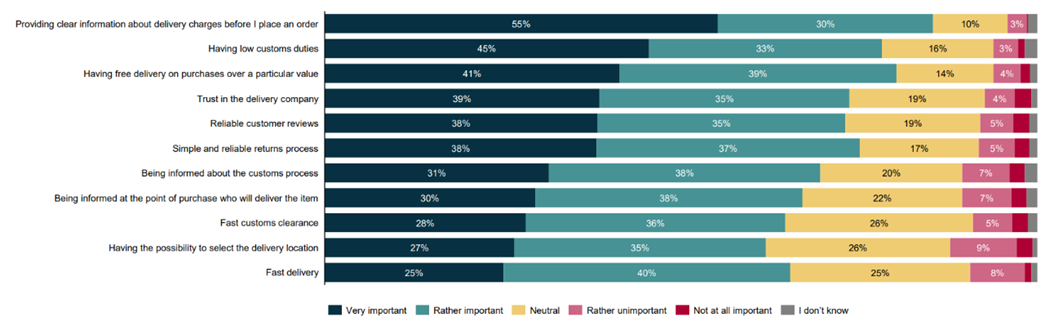
Source: IPC Cross-Border E-Commerce Shopper Survey 2025
One thing is particularly clear: transparent delivery costs, clear customs information, and trust in the shipping provider are more important than simply “fast delivery.” This is precisely where conversion, repeat purchases, and ratings are decided.
Price perception: ‘Expensive’ is okay, “unclear” is fatal
Swiss customers pay for quality and reliability. But they want to understand what they are paying for. You can be premium – but then you have to deliver: with consistent delivery quality, good packaging, clear communication, a fair returns process, and responsive support. Often, the provider that makes the risk “feel safe” wins.
Domain, hosting, and localization: what really matters
A .ch domain can help. But it's not the core. The core is your journey: CHF, local payments, clear cost logic, understandable language, reliable delivery, clean returns. If that's right, Swiss customers will feel at home with you – even if your warehouse is in Germany. In this blog, you'll learn everything you need to know about the customer requirements of Swiss people.
Marketplaces and sales channels
Marketplaces: Reach versus control
Whether it's an online marketplace in Switzerland or your own shop, marketplaces are very relevant in Switzerland. If you want to sell in Switzerland, they offer quick access to reach and trust. But they cost you margin and control.
When evaluating marketplaces, consider the following points:
- Fee structure and effective margin
- Opportunities for brand building
- Rules for product content and data
- Logistics and returns requirements
- Price parity and competitive pressure
- Scope for service and communication
For some product ranges, marketplaces are ideal for quickly building volume. For others, D2C is better because you control your experience and build stronger customer relationships in the long term.
D2C: Often the best start for SMEs and mid-market companies
Many growth-oriented retailers do well with D2C as their basis. You control pricing, product range, brand story, checkout, cost logic, and customer data. Whether through your own shop or a Swiss sales platform, D2C becomes particularly powerful when you operationalize the complexity of Switzerland. Then your shop is no longer a “foreign shop,” but a professional point of contact for anyone who wants to sell online in Switzerland.
In addition, Galaxus, as a major Swiss e-commerce player, can be a powerful lever – with over 8 million products and a wide reach. At the same time, you need very clean product data and stable delivery performance because offers are directly comparable.
Amazon, Zalando, and Co.: Not all channels are set up the same
Swiss customers also buy via international platforms. The pattern remains the same: if customers only pay upon delivery, there is friction. If everything is transparent and predictable, conversion and satisfaction increase. Fashion platforms also have to deal with returns – invest early in a stable returns process before you aggressively buy traffic. You can find a structured classification of the most important Swiss marketplaces here.
Common mistakes and best practices
Mistake 1: Unclear final prices
Customers see a price, are unsure at checkout, and abandon their purchase—or they buy and are disappointed later. This happens because retailers treat Switzerland like the EU and outsource customs realities to customers. Therefore, make a conscious decision to use DDP or DAP. With DDP, you communicate “all inclusive” clearly and visibly. With DAP, you explain specifically what happens and show an estimate or examples. Repeat the cost logic on the product page, in the shopping cart, at checkout, and in the order confirmation – in clear language instead of legal jargon.
Mistake 2: DAP without real transparency
Customers pay on delivery and feel surprised. Don't just write “fees may apply,” but explain the process in a few sentences. Use examples that match the price range of your products and make the information visible – not hidden in the terms and conditions.
Mistake 3: Data quality as “later”
Delays, queries, manual rework, and unclear fees are typical symptoms. Start with a core range and build a data profile for each product – with a description, weight, values, and notes. Maintain data as an ongoing process, not a one-off project. Clarify responsibilities internally and incorporate quality checks.
Mistake 4: Returns processes without a plan
When returns are improvised, costs rise and customers become dissatisfied. Therefore, plan returns from the outset, keep it simple and clear for customers, and communicate the refund transparently – i.e., time, method, and conditions. Good self-service content and clear emails noticeably reduce support queries.
Mistake 5: Checkout does not seem “Swiss”
Conversion is lower than expected, even though the product and price are right. Display CHF, offer local payment methods – at least TWINT and, depending on the target group, purchase on account – and keep the checkout process short, clean, and error-free. Use understandable language, not legal jargon.
Mistake 6: Support and communication are too “EU standard”
Customers feel they are not being taken seriously or are not getting enough clarity. Provide clear answers to the top questions: costs, delivery, returns, refunds. Use templates in emails and FAQs that are specific to Switzerland, and communicate proactively in the event of delays. This builds trust instead of losing it.
Mistake 7: Growth without stabilization
Marketing is running, volume is increasing, but operations are burning. Mistakes are piling up and reviews are turning negative. Therefore, scale not only traffic, but also processes. Define KPIs not only in conversion, but also in delivery quality, return rate, support tickets, and turnaround times. Conduct regular reviews: What is running smoothly, where are mistakes occurring, which products are causing problems? Stabilize first, then scale further.
Conclusion: Switzerland is demanding, but it's worth it.
Switzerland is a market with high purchasing power and high online affinity. At the same time, selling to Switzerland is operationally challenging. That's exactly why it's worthwhile for retailers who work cleanly.
You need a stable foundation:
- clear cost logic (DDP or transparent DAP)
- clean data and customs processes
- reliable delivery times and tracking
- local payments and CHF prices
- a returns strategy that takes customers seriously
- clear, simple communication
If you consistently implement these points, complexity will turn from a risk into a competitive advantage. And your shop will not feel like a foreign country to Swiss customers – but like a professional option where they will be happy to order again.
Sources
-
Swiss Post (2025): E-commerce sentiment barometer 2025.
-
International Post Corporation IPC (2026): Cross-border e-commerce shopper survey 2025.
-
Digitec Galaxus AG (2025): Galaxus: Sales climb by 18 percent.
-
Federal Tax Administration FTA (n.d.): Value added tax – main page.
-
Germany Trade & Invest GTAI (2023): Switzerland to abolish industrial tariffs from January 1, 2024.
-
International Post Corporation IPC (n.d.): Cross-Border E-Commerce Shopper Survey – main page.
-
State Secretariat for Economic Affairs SECO (n.d.): Abolition of industrial tariffs.
-
TWINT AG (2025): More than 6 million people in Switzerland rely on TWINT.
/logistikpartner-wechsel-breit.png?width=1200&name=logistikpartner-wechsel-breit.png)