
Tapping into the Swiss market: Why complex niche markets are worthwhile
/thumbnail%20schweizer-markt-erschliessen-cross-border-e-commerce.png?width=1440&height=720&name=thumbnail%20schweizer-markt-erschliessen-cross-border-e-commerce.png)
Table of contents
The blind spot in e-commerce: Why everyone is looking at the wrong markets
Germany, France, Italy – the usual suspects in European expansion. Large markets promise reach and rapid growth. But while hundreds of retailers compete for the same customers, a structural problem arises.
Price transparency continuously pushes margins down to 8–12 percent, while customer acquisition costs (CAC) rise by 15–20 percent annually. Marketing budgets are exploding, profitability is declining – growth is coming at a high price, not being generated organically.
Industry analyses have been showing strong growth in cross-border e-commerce for years – with a compound annual growth rate (CAGR) of over 23 percent until 2034. At the same time, Swiss online retail reached a volume of around CHF 18 billion in 2024 – a market that has more than doubled in ten years. Online sales account for 17.3 percent of total retail sales.
These figures show that growth is not only driven by market size, but also by the right market logic. The question is not where most consumers are, but where the best balance of demand, competition, and margin exists.
The key question: Do you scale through volume in saturated markets or through positioning in underserved ones?
Why Swiss consumers shop across borders
Reasons for cross-border online shopping in Switzerland:
.gif?width=1152&height=648&name=Design%20ohne%20Titel%20(4).gif)
Source: IPC Cross-Border E-Commerce Shopper Survey 2025: Switzerland
The motivation is clear: according to the IPC Shopper Survey 2025, 57 percent of Swiss consumers shop abroad because prices are lower. For you as a retailer, this means that your US prices are automatically attractive to Swiss consumers—you just need to make them visible.
International trade has always been driven by three key factors: price, availability, and product range. But which factor dominates in markets with high purchasing power but limited geographical size?
Empirical studies by the University of St. Gallen on internet and e-commerce use in Switzerland show that availability in particular is the decisive purchasing incentive for cross-border orders.
Swiss consumers shop internationally when products are not available locally or only available to a limited extent. This demand is structurally anchored. It does not arise from impulse or bargain hunting, but from genuine need. This is reflected in more stable shopping baskets, because buyers have already done their research and know what they want.
Return rates are lower because purchasing decisions are made more consciously. And willingness to pay is higher because, from the customer's point of view, availability justifies premium prices.
Cross-border e-commerce is thus the answer to fragmented demand in markets with high purchasing power. Those who fill this gap benefit from structural advantages.
Small markets, big margins: the strategic difference
Large markets such as Germany and France offer reach, but are highly competitive. The consequences are well known: high price transparency, intense competition, falling average margins.
Small, complex markets paint a different picture. Switzerland has a population of around 9.1 million, Norway around 5.6 million. Both markets are clearly demarcated by customs borders. Market analyses describe these markets as fragmented, with significantly fewer active suppliers per product category.
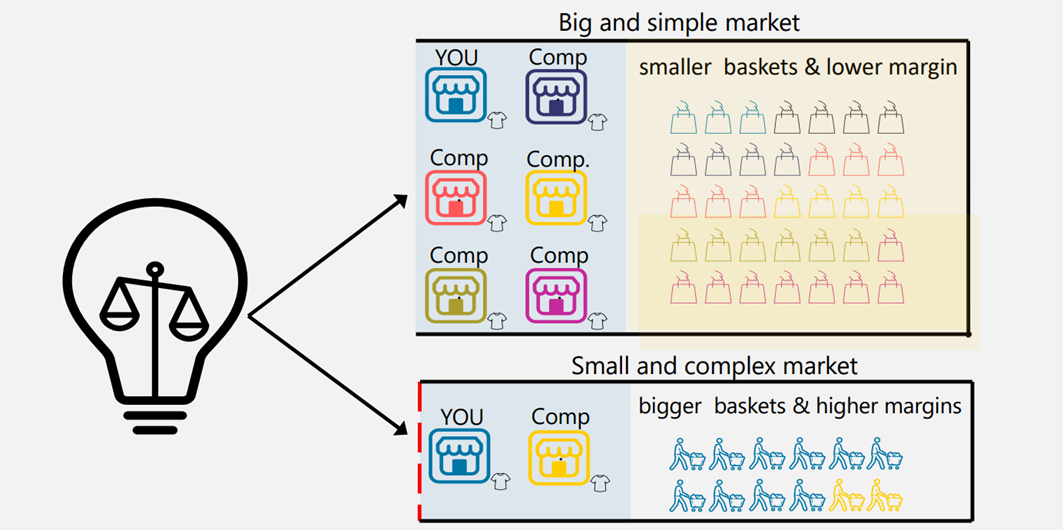
In large markets, many suppliers share small shopping baskets. In small, complex markets, a few suppliers benefit from larger shopping baskets and more stable margins.
A direct comparison reveals the structural differences in detail:
|
Criterion |
Major EU markets |
Switzerland / Norway |
|
Competition intensity |
High (many providers per category) |
Low (few specialized providers) |
|
Average AOV |
45–65 EUR |
120–180 CHF (~110–165 EUR) |
|
Price sensitivity |
High |
Medium to low |
|
Market entry barrier |
Low |
High (customs, regulation) |
|
Margin stability |
Declining |
Stable |
This lower level of competition leads to higher market shares per provider, more stable shopping baskets, and lower price sensitivity. Scaling here is achieved not through volume, but through positioning and operational capability.
Experience from established cross-border setups: Shopping baskets in Switzerland are often two to three times higher than the EU average. This factor compensates for higher entry costs and creates sustainable competitive advantages.
Small, affluent niche markets such as Switzerland, Norway, and Iceland share this structure: high purchasing power, limited local availability, and operational barriers to entry result in above-average margins. Customs borders do not act as an obstacle, but rather as a natural margin protector—a barrier that shields established providers from price pressure.
Switzerland in detail: purchasing power, conversion, and customs barriers
Purchasing power and market potential
Switzerland is one of the consumer markets with the highest purchasing power worldwide. This is also reflected in online retail: according to Handelsverband.swiss, online sales have more than doubled in the last ten years. Market analyses predict that Swiss e-commerce could reach a volume of over USD 20 billion in the medium term.
Conversion drivers and purchasing behavior
Studies on internet usage in Switzerland show that delivery conditions, cost transparency, and availability are among the most important purchasing criteria. Swiss consumers are experienced online shoppers. They read delivery conditions carefully and are highly sensitive to a lack of transparency.
Notes such as “additional customs and tax costs possible” have been proven to be conversion killers. They create uncertainty and lead to abandoned purchases at checkout. Conversely, practical experience shows that clear DDP communication (Delivered Duty Paid – all costs already included in checkout) creates trust and measurably increases the conversion rate.
What does DDP mean in concrete terms? The final price at checkout includes all costs, including customs duties and taxes. The customer pays exactly the amount displayed – no surprises upon delivery.
The customs barrier as a strategic advantage
The customs border acts as a barrier to entry. Many international suppliers refrain from entering the market because they shy away from or underestimate the operational effort involved. However, those who overcome this barrier benefit immediately.
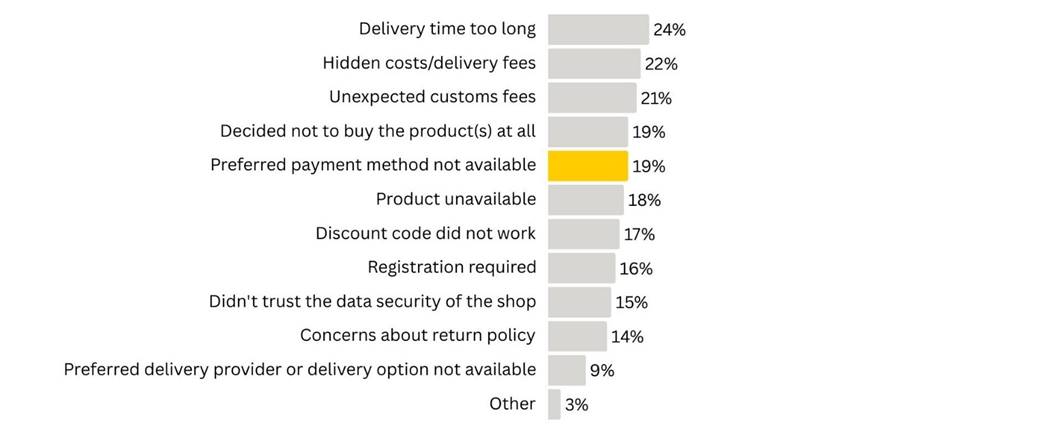
The IPC Shopper Survey 2025 shows where Swiss consumers abandon their purchases: unexpected customs fees (21%), hidden delivery costs (22%), and excessively long delivery times (24%) are the three most common reasons for abandonment. Together, they account for two-thirds of all shopping cart abandonments in cross-border business.
Source: IPC Cross-Border E-Commerce Shopper Survey 2025: Switzerland
Do not forget payment
Another striking feature of the chart is that 19% of Swiss online shoppers abandon their purchase if their preferred payment method is not available. Anyone entering the Swiss market should consider not only customs and logistics, but also the payment setup from the outset. Here you can find out which payment methods are really important in the Swiss market.
Do not forget payment
Another striking feature of the chart is that 19% of Swiss online shoppers abandon their purchase if their preferred payment method is not available. Anyone entering the Swiss market should consider not only customs and logistics, but also the payment setup from the outset. Here you can find out which payment methods are really important in the Swiss market.
The three customs-related reasons for abandonment can be addressed with a single operational lever: DDP. Displaying the final price including all customs duties and taxes at checkout eliminates uncertainty—and thus the most common reasons for abandonment. One indicator of this effect: retailers in the SmartGate network who have switched to complete DDP transparency have seen their Swiss customer base grow by over 40 percent since Q1 2024.
In economic theory, barriers to entry are considered an effective means of protecting margins. In cross-border e-commerce, regulatory requirements, data quality, and process expertise play exactly this role. They protect established providers from price-driven competitors and enable stable margins over longer periods of time.
The operational reality: What holds retailers back—and how to solve it
Industry reports and operational experience show recurring challenges when entering the Swiss market. In terms of data quality and compliance, retailers regularly encounter incomplete or incorrect HS codes, missing weight specifications, unclear country of origin declarations, and ABD uncertainties for goods valued at over EUR 1,000. In terms of cost structure and transparency, opaque customs costs deter buyers, high first-mile costs due to inefficient processes weigh on margins, and an unclear overall cost structure makes calculation difficult. Added to this are local requirements: missing payment methods such as Twint – long standard in Switzerland – inefficient or non-existent return processes, and a lack of German-speaking customer support cost conversion and customer satisfaction.
These problems are well known and solvable. The key is not perfection from day one, but a focused start with a clear division of responsibilities.
The structured start in 8 weeks
Weeks 1–2: Validate market fit and build data quality
- Analyze top 50 products: Are they available locally in Switzerland?
- Check search volume (Google Trends CH) for your categories
- Verify HS codes for top 20% products (by sales)
- Complete product data (weight, dimensions, origin)
Weeks 3–4: Create transparency at checkout
- Activate DDP model (all costs included)
- Clear communication: “Final price incl. customs and taxes – no hidden costs”
- Integrate local payment method (Twint increases conversion by 15–25%)
- Communicate realistic delivery times (48–72 hours is feasible)
Weeks 5–6: Soft launch and partner integration
- Traffic test with CHF 500–1,000 ad budget (Google/Meta)
- Track conversion rate (target: > 2.5% for niche products)
- Integrate specialized cross-border logistics providers
- Measure end-to-end delivery times (target: < 48 hours to delivery)
Weeks 7–8: Optimization and scaling
- Run through the entire returns process once
- Calculate CAC vs. LTV (break-even usually occurs with the second order)
- Scale up budget if unit economics are right (CAC/LTV < 0.3)
- Expand product range based on initial data
Success criteria after 8 weeks:
- At least 20 orders successfully processed
- Average shopping cart > CHF 100
- No unresolved customs or compliance issues
- Return rate < 15%
Solutions such as SmartGate Flex enable scalable market entry: integration via plugin or API, commercial processing from the first euro of goods value, integrated returns management, and end-to-end transit times of up to 48 hours.
This is what the process looks like in practice:
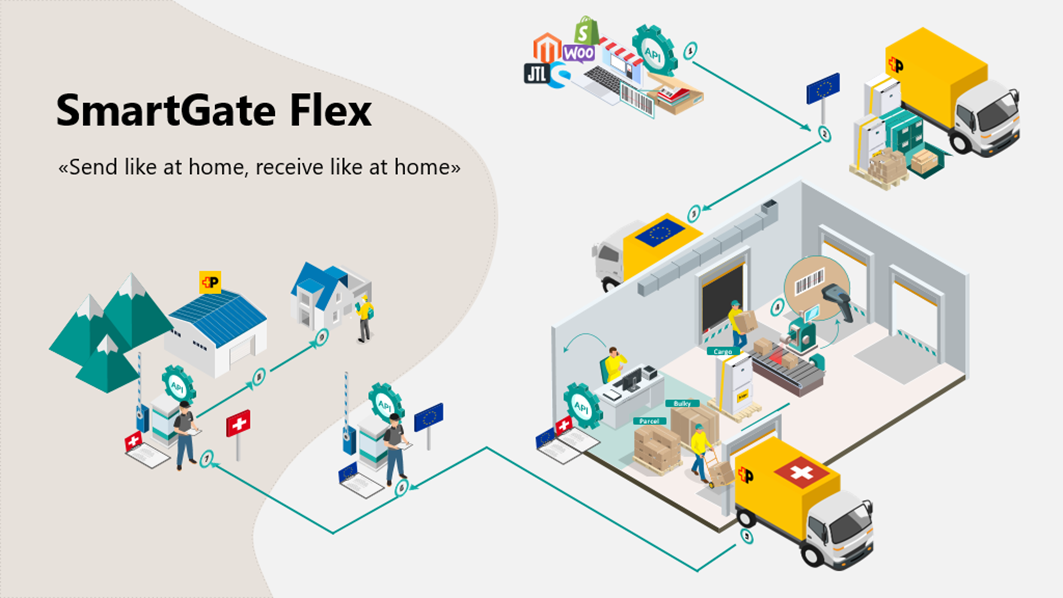
SmartGate Flex: From the shop system to cross-docking and customs clearance to delivery by Swiss Post—the entire process from a single source.
The advantage of this setup is that retailers can utilize their existing infrastructure and transfer the complexity of customs clearance, transport, and last-mile delivery to a specialized partner. This lowers the barrier to entry and significantly reduces the time to first sale in Switzerland.
The time factor: Why “later” becomes more expensive
Two parallel developments are changing market dynamics and creating a temporary window of opportunity for first-mover advantages:
Development 1: Technological simplification
AI-supported HS code classification is becoming standard and significantly reducing data requirements.
At the same time, automated customs clearance reduces operational complexity, while integrated payment and logistics stacks are emerging that bring together previously separate processes. API-based connections are increasingly replacing manual processes and making market entry more technically accessible than ever before.
Development 2: Global competition internationalizes
International platforms show how global players scale into new markets. Their processes are completely data-driven – from product classification to customs tariffing, everything is automated. Localization is not a special project, but standard: payment methods, language, and customer service are consistently tailored to the respective market. End-to-end data quality minimizes manual intervention and keeps error rates low, while scalable infrastructures make it possible to roll out the same processes in parallel for many markets.
Not everything can be transferred one-to-one – European retailers have different cost structures and margins. But the principles apply: data quality, process standardization, and clear customer experiences determine scalability.
The consequences for your market entry
The structural advantages of complex markets today will erode over the next 3–5 years. Those who invest now will secure market share in underserved categories and build operational maturity before the next wave of competition sets in. At the same time, customer loyalty is created before alternatives increase massively – and the experience gained from the first complex market becomes a strategic asset for every subsequent one.
The sweet spot is now: barriers are high enough to limit competition, but low enough to scale profitably with a focused approach.
Learning from global platforms: What Temu and Shein are demonstrating
The rapid expansion of platforms such as Temu and Shein in cross-border e-commerce provides valuable insights – regardless of whether one considers their business model to be transferable or not.
The IPC Shopper Survey 2025 shows the reality: Temu is already one of the most widely used international e-retailers in Switzerland – on par with established players such as Amazon and Zalando. This is not a niche phenomenon, but your direct competitive reality.
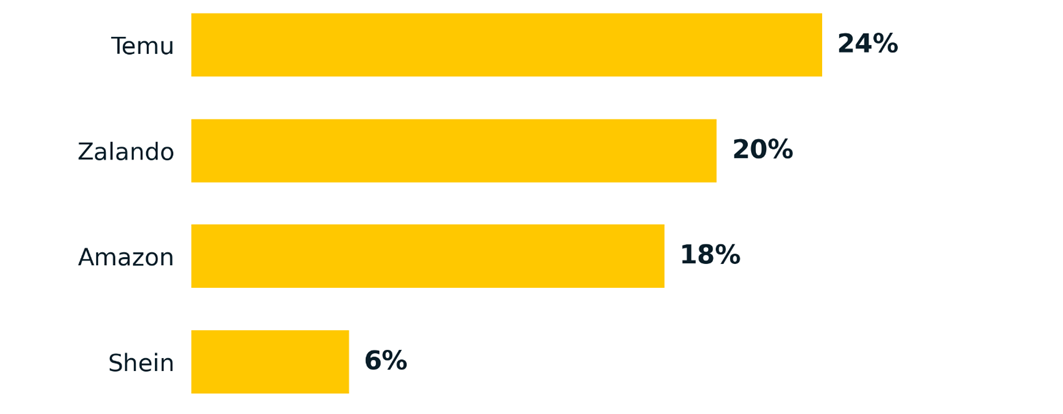
Most popular international e-retailers among Swiss cross-border shoppers. Source: IPC Cross-Border E-Commerce Shopper Survey 2025: Switzerland
The question is not whether these platforms influence the market, but what you can learn from their operating methods.
Four lessons for European retailers
- Data quality as a foundation Temu and Shein have built their entire value chain on data. From product classification to customs tariffing, everything is automated. According to industry analysis, both platforms use AI-powered systems that analyze product descriptions and assign HS codes in real time. The result: minimal manual intervention, low error rates, and faster customs clearance. Transferable: Even medium-sized retailers can now use AI tools for customs tariff classification. Providers such as Avalara, Zonos, and Digicust offer automated HS code classification that can be integrated into existing shop systems.
- Localization as standard, not as an exception Shein offers localized payment methods, languages, and price displays in over 150 countries. The platform adapts to the respective market – not the other way around. This consistent localization is a key conversion driver. Transferable: For Switzerland, this means integrating Twint, displaying prices in CHF, and offering German-language support. These measures can be implemented with manageable effort and have a direct impact on the conversion rate.
- Direct-to-consumer (DTC) as a margin lever Both platforms operate according to the “factory-to-consumer” model and eliminate intermediaries. This not only reduces costs, but also enables faster response times to market changes. Transferable: European retailers can achieve similar efficiency gains through direct partnerships with specialized cross-border logistics providers – without having to restructure their entire supply chain.
- Customer experience through transparency: A key success factor is complete cost transparency at checkout. Customers see the final price including all fees – no additional charges upon delivery. This principle corresponds exactly to the DDP model, which is also crucial for European retailers doing business in Switzerland.
What cannot be transferred
Not all strategies are sensible or ethically justifiable for European retailers. Temu's aggressive pricing policy is based on subsidies of 20-30 percent per order in some cases – a model that focuses on market share gains rather than profitability. The use of duty-free limits (de minimis rules) is also coming under increasing regulatory pressure.
The bottom line: The operating principles – data quality, automation, localization, and transparency – are universally applicable. The specific tactics must be adapted to European cost structures and compliance requirements.
Beyond Switzerland: The niche market playbook
Switzerland is not an isolated case, but rather a blueprint for an entire category of markets. Small, complex markets share the same basic structure: purchasing power + limited local availability + operational barriers = above-average margins.
Norway, Iceland, and other markets such as Dubai/UAE, Israel, and Singapore follow this pattern. Those who have successfully tapped into the Swiss market can apply the same playbook with minimal adjustments. The operational learning curve becomes a strategic asset.
Vision “No Border”: The Future of Global E-Commerce
Imagine a coffee farmer in Nigeria. Today, he sells his harvest to local middlemen at prices that barely cover production costs. The value creation takes place elsewhere: with exporters, roasters, distributors, and retailers in Europe or North America.
The thought experiment
What if this farmer could sell his coffee directly to end customers in Zurich, Paris, or Singapore? Not through complex retail chains, but via a simple e-commerce platform—with automated customs clearance, transparent shipping costs, and local payment processing?

Technically, this is already possible today. The building blocks exist: AI-supported customs tariff classification, integrated logistics APIs, DDP-enabled shipping solutions, localized checkout systems. What is missing is the widespread application of these technologies – especially in markets that are considered “too complex.”
Grenzen verlieren an Bedeutung
Die Vision „No Border" beschreibt eine Welt, in der geografische und regulatorische Grenzen im Handel zunehmend an Bedeutung verlieren. Nicht weil Zölle oder Vorschriften verschwinden, sondern weil Technologie sie handhabbar macht. Die Komplexität wird in Software übersetzt – und damit skalierbar.
Für E-Commerce-Händler bedeutet das: Die Fähigkeit, komplexe Märkte zu erschliessen, wird vom Differenzierungsmerkmal zur Grundkompetenz. Wer diese Fähigkeit heute aufbaut, ist auf die nächste Phase des globalen Handels vorbereitet.
Die Schweiz als Trainingsgelände
Die Schweiz ist das ideale Testfeld für diese Zukunft. Ein Markt mit klaren regulatorischen Anforderungen, hoher Kaufkraft und anspruchsvollen Konsumenten. Wer hier erfolgreich operiert, hat bewiesen, dass sein Setup auch für andere komplexe Märkte funktioniert.
Die Learnings aus dem Schweiz-Geschäft – Datenqualität, DDP-Prozesse, lokale Zahlungsmethoden, Retourenmanagement – sind direkt übertragbar auf Norwegen, Island, die Golfregion oder asiatische Märkte. Die Schweiz ist nicht das Ziel, sondern der Startpunkt einer globalen Strategie.
Summary: The three decisions that are now pending
The facts speak for themselves. Swiss online retail has reached a volume of CHF 18 billion, with online sales accounting for 17.3 percent of total retail sales – and growth potential of over 25 percent in five years. Retailers in the SmartGate network have seen DDP customer growth of over 40 percent since Q1 2024, and average shopping carts in Switzerland are two to three times higher than in major EU markets.
The crucial question is not whether it is worth getting started, but how consistently you approach it now.
Decision 1: Market prioritization Do you start with Switzerland as a pilot market or do you first compare Switzerland vs. Norway? Focusing accelerates the process, but a systematic comparison can optimize the correct sequence.
Decision 2: Cost model DDP from the outset (greater transparency, better conversion) or DDU with the risk of high abandonment rates and customer dissatisfaction? The data is clear: DDP pays off.
Decision 3: Implementation partner In-house with gradual development (more control, longer learning curve) or structured setup with a specialized partner (faster go-live, external dependency)? The answer depends on your internal resources and risk tolerance.
Switzerland is no exception. It is a blueprint for how small, complex markets offer disproportionate opportunities in cross-border e-commerce – now more than ever. While other retailers focus on saturated large markets, you can secure market share where demand meets limited supply.
Sources
-
Handelsverband.swiss (2024): Onlinehandelsmarkt Schweiz 2024 (Swiss online retail market 2024).
-
Market.us (2025): Cross-border E-commerce Market Size – CAGR of 23.5%. https://market.us/report/cross-border-e-commerce-market/
-
Business of Fashion / McKinsey & Company (2024): The State of Fashion 2024 – Fast Fashion Analysis.
-
TechBuzz China (2024): Temu Watch #5 – Logistics, Marketing, AI.
-
TechBuzz China (2024): Shein 2024 Update – Global Growth, Logistics, Assortment.
-
World Customs Organization WCO (2022): How AI can help Customs in automating HS Classification.
-
Federal Office for Customs and Border Security FOCBS: Customs information for businesses.
/logistikpartner-wechsel-breit.png?width=1200&name=logistikpartner-wechsel-breit.png)